%4d%69%6e%6b%65%65%20%43%68%6f%69
-
 KAIST Tames a Semiconductor Greenhouse Gas 6,000 Times More Potent Than CO₂ with the ‘Power of Disorder’
Among the gases used in semiconductor manufacturing, tetrafluoromethane (CF₄) is a greenhouse gas over 6,000 times more potent than carbon dioxide. A KAIST research team has developed a technology that removes this gas with high efficiency while extending the usable lifetime of the catalyst that helps break it down by harnessing the ‘power of disorder,’ in which mixing multiple metal atoms together actually stabilizes the catalyst’s structure.
KAIST (President Choongsik Bae) announced on September 3 that a research team led by Professor Minkee Choi from the Department of Chemical and Biomolecular Engineering, working in collaboration with researchers from Samsung Electronics, has developed a new catalyst capable of removing CF₄, a greenhouse gas used in processes such as the fabrication of fine semiconductor circuits with high efficiency over long periods of use.
CF₄ is used in processes such as dry etching, in which unwanted portions of a semiconductor wafer are selectively removed to create fine circuit patterns. The problem lies in the CF₄ left over after use. Because its carbon and fluorine atoms are bound together extremely tightly, the gas does not easily decompose, and once released into the atmosphere, it can persist for roughly 50,000 years. Its impact on global warming is also more than 6,000 times greater than that of carbon dioxide.
To prevent CF₄ from being released as is, semiconductor manufacturing sites currently decompose it at high temperatures using steam and a catalyst. A catalyst speeds up chemical reactions, much like those used to reduce pollutants in car exhaust.
However, conventional catalysts have suffered from declining performance the longer they are used. This is because hydrogen fluoride (HF), generated as CF₄ decomposes, combines with moisture to create a highly corrosive environment, causing the catalyst’s fine particles to aggregate or its structure to change. When small catalyst particles clump together into larger masses, the surface area in contact with the CF₄ to be treated shrinks, and performance declines accordingly.
The research team solved this problem, paradoxically, by harnessing the ‘power of disorder.’
Mixing multiple atom types creates a complex, disordered structure that resists phase changes and remains stable. This process is called entropy stabilization. In simple terms, it is a principle in which evenly mixing multiple kinds of atoms makes it difficult for a catalyst to clump together or change into another structure.
Using this principle, the research team evenly incorporated multiple metals — aluminum (Al), zinc (Zn), gallium (Ga), nickel (Ni), and cobalt (Co) — into a single aluminate crystal structure. Aluminate is a material in which several metals are bonded around a basic framework of aluminum and oxygen. Through this approach, the team developed an ‘entropy-stabilized aluminate (ESA) catalyst’ that resists aggregation and structural deformation even under the harsh conditions of high temperature, moisture, and fluorine occurring together.
The performance gap was clear. The new catalyst’s intrinsic activity for decomposing CF₄ was approximately 2.3 times higher than that of a conventional alumina catalyst. Notably, in an accelerated test conducted at about 800°C for 150 hours, the CF₄ conversion of the conventional alumina catalyst dropped from 93% to 48%. The new catalyst, by contrast, maintained a high level, declining only from 98% to 92%. This demonstrated that the catalyst can remove CF₄ with high efficiency while sustaining its performance over extended periods.
The researchers also revealed the decomposition mechanism of CF₄. To do this, they used oxygen isotopes, which allow the movement of oxygen atoms to be tracked. In simple terms, this involves attaching a ‘tag’ to oxygen atoms so that where the oxygen comes from and where it moves to during the reaction can be traced.
The results confirmed that the catalyst first uses the oxygen within its own structure to decompose CF₄, and that the reaction continues as surrounding steam replenishes the oxygen that has been depleted. In effect, the catalyst functions as a kind of ‘oxygen refill system,’ in which steam restores the oxygen the catalyst draws upon. Through this, the research team provided the world’s first experimental confirmation of a CF₄ decomposition process that had previously only been proposed in theory.
The significance of this research goes beyond developing a single catalyst that decomposes CF₄ effectively; it presents a new catalyst design strategy capable of achieving both high decomposition performance and a long service life at the same time. The approach is expected to be applicable to the future development of catalysts for treating a range of semiconductor process gases by varying the types and combinations of metals used.
Professor Choi said, “By applying the principle that disorder in nature can actually make a structure more stable to catalyst design, we achieved both high CF₄ decomposition performance and long-term stability at the same time.” He added, “This work is meaningful in that it presents a new materials design strategy that can be extended to catalysts for treating a range of semiconductor process gases by varying the types and combinations of metals used.”
The study was led by Dr. Seunghyuck Chi, a postdoctoral researcher in KAIST’s Department of Chemical and Biomolecular Engineering, who served as first author, with researchers from Samsung Electronics participating as co-authors. The findings were published in June in the international chemistry journal Angewandte Chemie International Edition.
Paper title: Entropy-Stabilized Aluminate Catalysts that Break the Activity–Stability Tradeoff in CF₄ Hydrolysis,
DOI: 10.1002/anie.6752036
This research was supported by the National Research Foundation of Korea (RS‐2024‐00333937 and RS‐2024‐00405261).
2026.09.03 View 3209
-
 KAIST Develops Novel Catalyst With 100-Fold Platinum Efficiency
Propylene, a key building block used in producing plastics, textiles, automotive components, and electronics, is essential to the petrochemical industry. A KAIST research team has developed a novel catalyst that dramatically enhances the efficiency of propylene production while significantly reducing costs.
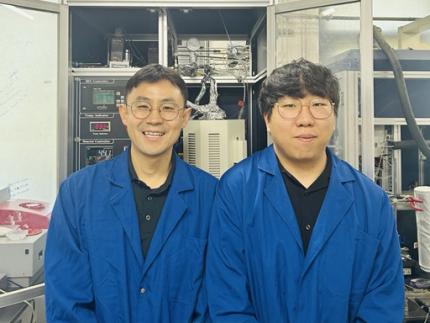
< Photo. Professor Minkee Choi (left), and Ph.D. Candidate Susung Lee (right) of the Department of Chemical and Biomolecular Engineering >
KAIST (represented by President Kwang-Hyung Lee) announced on the 12th of May that a research group led by Professor Minkee Choi from the Department of Chemical and Biomolecular Engineering has successfully developed a new catalyst using inexpensive metals—gallium (Ga) and alumina (Al₂O₃)—with only a trace amount of platinum (100 ppm, or 0.01%). Remarkably, this new catalyst outperforms conventional industrial catalysts that use high concentrations of platinum (10,000 ppm).
Propylene is commonly produced through the propane dehydrogenation (PDH) process, which removes hydrogen from propane. Platinum has long been used as a catalyst in PDH due to its high efficiency in breaking carbon-hydrogen bonds and facilitating hydrogen removal. However, platinum is costly and suffers from performance degradation over repeated use.
To address this, the KAIST team engineered a catalyst that incorporates only a minimal amount of platinum, relying on gallium and alumina as the primary components.
< Figure 1. Schematic diagram showing the catalytic cooperation between gallium (Ga) and platinum (Pt) >
The core mechanism of the catalyst involves a cooperative function between the metals: gallium activates the C–H bond in propane to produce propylene, while platinum bonds the residual hydrogen atoms on the surface to form hydrogen gas (H₂), which is then released. This division of roles allows for high catalytic efficiency despite the drastic reduction in platinum content.
The researchers identified an optimal platinum-to-gallium ratio that delivered peak performance and provided a scientific rationale and quantitative metrics to predict this ideal composition.
Additionally, the team addressed a major limitation of traditional platinum catalysts: sintering—the agglomeration of platinum particles during repeated use, which causes performance loss. By adding a small amount of cerium (Ce), the researchers successfully suppressed this aggregation. As a result, the new catalyst maintained stable performance even after more than 20 reaction-regeneration cycles.
< Figure 2. Performance comparison of KAIST's newly developed catalyst (100 ppm platinum) and existing commercial platinum catalyst (10,000 ppm platinum) >
Professor Choi stated, “This research demonstrates the possibility of reducing platinum usage to 1/100th of current levels without compromising, and even enhancing, performance. It presents significant economic and environmental advantages, including lower catalyst costs, extended replacement intervals, and reduced catalyst waste.”
He added, “We are planning to evaluate this technology for large-scale process demonstration and commercialization. If adopted in industry, it could greatly improve the economic viability and efficiency of propylene production.”
The study was led by Professor Minkee Choi as corresponding author, with Ph.D. candidate Susung Lee as the first author. The findings were published in the Journal of the American Chemical Society (JACS), a leading journal in chemistry and chemical engineering, on February 13.※ Paper title: Ideal Bifunctional Catalysis for Propane Dehydrogenation over Pt-Promoted Gallia-Alumina and Minimized Use of Precious Elements※ DOI: https://pubs.acs.org/doi/10.1021/jacs.4c13787
The research was supported by the National Research Foundation of Korea and Hanwha Solutions Corporation.
2025.05.12 View 8026
-
 KAIST Develops World-Leading Ammonia Catalyst for Hydrogen Economy
Hydrogen production using renewable energy is a key technology for eco-friendly energy and chemical production. However, storing and transporting hydrogen remains a challenge. To address this, researchers worldwide are investigating methods to store hydrogen in the form of ammonia (NH₃), which is carbon-free and easier to liquify. A research team at KAIST has successfully developed a high-performance catalyst that enables ammonia synthesis at very low temperatures and pressures without energy loss.
KAIST (represented by President Kwang Hyung Lee) announced on the 11th of March that a research team led by Professor Minkee Choi from the Department of Chemical and Biomolecular Engineering has developed an innovative catalytic system that significantly enhances ammonia production while drastically reducing energy consumption and CO₂ emissions.
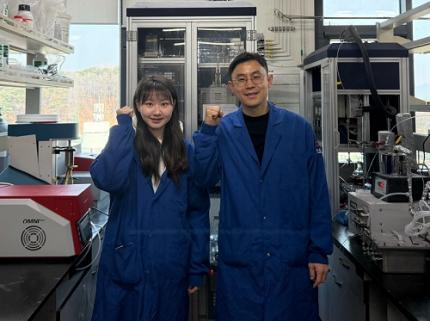
< (From left) Baek Ye-jun, Ph.D. candidate in the Department of Biochemical Engineering, Professor Choi Min-ki >
Currently, ammonia is produced using the Haber-Bosch process, a technology over a century old that relies on iron (Fe)-based catalysts. This method requires extreme conditions—temperatures above 500°C and pressures exceeding 100 atmospheres—resulting in enormous energy consumption and contributing significantly to global CO₂ emissions. Additionally, ammonia is primarily produced in large-scale industrial plants, leading to high distribution costs.
As an alternative, there is growing interest in an eco-friendly process that synthesizes ammonia using green hydrogen—produced via water electrolysis—under mild conditions (300°C, 10 atmospheres). However, developing catalysts that can achieve high ammonia productivity at such low temperatures and pressures is essential, as current technologies struggle to maintain efficiency under these conditions.
The research team developed a novel catalyst by incorporating ruthenium (Ru) nanoparticles and highly basic barium oxide (BaO) particles onto a conductive carbon surface, allowing it to function like a chemical capacitor*.
*Capacitor: A device that stores electrical energy by separating positive and negative charges.
During ammonia synthesis, hydrogen molecules (H₂) first dissociate into hydrogen atoms (H) on the ruthenium catalyst. These hydrogen atoms are further split into protons (H⁺) and electrons (e⁻). The study revealed that the acidic protons are stored in the strongly basic BaO, while the remaining electrons are separated and stored in ruthenium and carbon.
This unique chemical capacitor effect significantly enhances the ruthenium catalyst's electron density, accelerating nitrogen (N₂) dissociation—the rate-limiting step of ammonia synthesis—thereby dramatically increasing catalytic activity.
Furthermore, the team discovered that optimizing the nanostructure of the carbon material further boosts the electron density of ruthenium, maximizing catalytic performance. As a result, the new catalyst demonstrated over seven times higher ammonia synthesis performance compared to state-of-the-art catalysts under mild conditions (300°C, 10 atm).
< Schematic diagram showing the mechanism of ruthenium catalyst activity enhancement by barium oxide cocatalyst >
Professor Minkee Choi stated, “This research has garnered significant attention for demonstrating that catalytic activity can be greatly enhanced by controlling electron transfer within a thermal catalytic reaction system, not just in electrochemical processes.”
He further explained, “Our findings confirm that high-performance catalysts can enable efficient ammonia synthesis under low-temperature and low-pressure conditions. This could shift ammonia production from centralized, large-scale industrial plants to decentralized, small-scale production, making the hydrogen economy more sustainable and flexible.”
The study was led by Professor Minkee Choi as corresponding author and Yaejun Baik, a Ph.D. candidate, as first author. The research findings were published in Nature Catalysis on February 24.
(Paper title: “Electron and proton storage on separate Ru and BaO domains mediated by conductive low-work-function carbon to accelerate ammonia synthesis,” https://doi.org/10.1038/s41929-025-01302-z)
This research was supported by the Korea Institute of Energy Research and the National Research Foundation of Korea.
2025.03.11 View 11656