KAIST Develops OLED Technology with Double the Screen Brightness
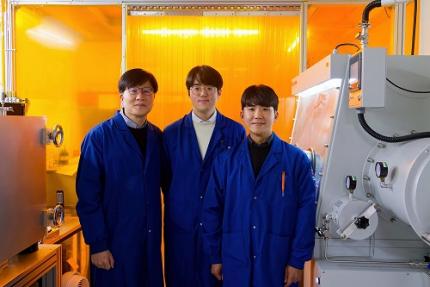
<(From Left) Ph.D candidate Minjae Kim, Professor Seunghyup Yoo, Dr. Junho Kim>
Organic light-emitting diodes (OLEDs) are widely used in smartphones and TVs thanks to their excellent color reproduction and thin, flexible planar structure. However, internal light loss has limited further improvements in brightness. KAIST researchers have now developed a technology that more than doubles OLED light-emission efficiency while maintaining the flat structure that is a key advantage of OLED displays.
KAIST (President Kwang Hyung Lee) announced on the 11th of January that a research team led by Professor Seunghyup Yoo of the School of Electrical Engineering has developed a new near-planar light outcoupling structure* and an OLED design method that can significantly reduce light loss inside OLED devices.* Near-planar light outcoupling structure: a thin structure that keeps the OLED surface almost flat while extracting more of the light generated inside to the outside
OLEDs are composed of multiple layers of ultrathin organic films stacked on top of one another. As light passes through these layers, it is repeatedly reflected or absorbed, often causing more than 80% of the light generated inside the OLED to be lost as heat before it can escape.
To address this issue, light outcoupling structures such as hemispherical lenses or microlens arrays (MLAs) have been used to extract light from OLEDs. However, hemispherical lenses protrude significantly, making it difficult to maintain a flat form factor, while MLAs must cover much larger area than individual pixel sizes to achieve sufficient light extraction. This creates limitations in achieving high efficiency without interference between neighboring pixels.
To increase OLED brightness while preserving a planar structure, the research team proposed a new OLED design strategy that maximizes light extraction within the size of each individual pixel.
Unlike conventional designs that assume OLEDs extend infinitely, this approach takes into account the finite pixel sizes actually used in real displays. As a result, more light can be emitted externally even from pixels of the same size.
In addition, the team developed a new near-planar light outcoupling structure that helps light emerge efficiently in the forward direction without being spread too widely. This structure is very thin—comparable in thickness to existing microlens arrays—yet achieves light extraction efficiency close to that of hemispherical lenses of the same lateral dimension. As a result, it hardly undermines the flat form factors of OLEDs and can be readily applied to flexible OLED displays.
By combining the new OLED design with the near-planar light outcoupling structure, the researchers successfully achieved more than a twofold improvement in light-emission efficiency even in small pixels.
< Quasi-Planar Light Extraction OLED Technology >
This technology enables brighter displays using the same power while maintaining OLED’s flat structure, and is expected to extend battery life and reduce heat generation in mobile devices such as smartphones and tablets. Improvements in display lifespan are also anticipated.
MinJae Kim, the first author of the study, noted, “A small idea that came up during class was developed into real research results through the KAIST Undergraduate Research Program (URP).”
Professor Seunghyup Yoo stated, “Although many light outcoupling structures have been proposed, most were designed for large-area lighting applications, and many were difficult to apply effectively to displays composed of numerous small pixels,” adding, “The near-planar light outcoupling structure proposed in this work was designed with constraints on the size of the light source within each pixel, reducing optical interference between adjacent pixels while maximizing efficiency.” He further emphasized that the approach can be applied not only to OLEDs but also to next-generation display technologies based on materials such as perovskites and quantum dots.
< Schematic Overview and Application Examples of the Proposed Light Extraction Structure >
This research, with MinJae Kim (Department of Materials Science and Engineering, KAIST; currently a Ph.D. student in Materials Science and Engineering at Stanford University) and Junho Kim (School of Electrical Engineering, KAIST; currently a postdoctoral researcher at the University of Cologne, Germany) as co–first authors, was published online on December 29, 2025, in Nature Communications.
※ Paper title: “Near-planar light outcoupling structures with finite lateral dimensions for ultra-efficient and optical crosstalk-free OLED displays” DOI: 10.1038/s41467-025-66538-6
This research was supported by the KAIST Undergraduate Research Program (URP), the Mid-Career Researcher Program and the Future Display Strategic Research Lab Program of the National Research Foundation (NRF) of Korea, the Human Resource Development Program of the Korea Institute for Advancement of Technology (KIAT), and the Korea Planning & Evaluation Institute of Industrial Technology (KEIT).
KAIST Develops World’s First Wireless OLED Contact Lens for Retinal Diagnostics
<ID-style photograph against a laboratory background featuring an OLED contact lens sample (center), flanked by the principal authors (left: Professor Seunghyup Yoo ; right: Dr. Jee Hoon Sim). Above them (from top to bottom) are: Professor Se Joon Woo, Professor Sei Kwang Hahn, Dr. Su-Bon Kim, and Dr. Hyeonwook Chae>
Electroretinography (ERG) is an ophthalmic diagnostic method used to determine whether the retina is functioning normally. It is widely employed for diagnosing hereditary retinal diseases or assessing retinal function decline.
A team of Korean researchers has developed a next-generation wireless ophthalmic diagnostic technology that replaces the existing stationary, darkroom-based retinal testing method by incorporating an “ultrathin OLED” into a contact lens. This breakthrough is expected to have applications in diverse fields such as myopia treatment, ocular biosignal analysis, augmented-reality (AR) visual information delivery, and light-based neurostimulation.
On the 12th, KAIST (President Kwang Hyung Lee) announced that a research team led by Professor Seunghyup Yoo from the School of Electrical Engineering, in collaboration with Professor Se Joon Woo of Seoul National University Bundang Hospital (Director Jeong-Han Song), Professor Sei Kwang Hahn of POSTECH (President Sung-Keun Kim) and CEO of PHI Biomed Co., and the Electronics and Telecommunications Research Institute (ETRI, President Seungchan Bang) under the National Research Council of Science & Technology (NST, Chairman Youngshik Kim), has developed the world’s first wireless contact lens-based wearable retinal diagnostic platform using organic light-emitting diodes (OLEDs).
<Figure 1. Schematic and photograph of the wireless OLED contact lens>
This technology enables ERG simply by wearing the lens, eliminating the need for large specialized light sources and dramatically simplifying the conventional, complex ophthalmic diagnostic environment.
Traditionally, ERG requires the use of a stationary Ganzfeld device in a dark room, where patients must keep their eyes open and remain still during the test. This setup imposes spatial constraints and can lead to patient fatigue and compliances challenges.
To overcome these limitations, the joint research team integrated an ultrathin flexible OLED —approximately 12.5 μm thick, or 6–8 times thinner than a human hair— into a contact lens electrode for ERG. They also equipped it with a wireless power receiving antenna and a control chip, completing a system capable of independent operation.
For power transmission, the team adopted a wireless power transfer method using a 433 MHz resonant frequency suitable for stable wireless communication. This was also demonstrated in the form of a wireless controller embedded in a sleep mask, which can be linked to a smartphone —further enhancing practical usability.
<Figure 2. Schematic of the electroretinography (ERG) testing system using a wireless OLED contact lens and an example of an actual test in progress>
While most smart contact lens–type light sources developed for ocular illumination have used inorganic LEDs, these rigid devices emit light almost from a single point, which can lead to excessive heat accumulation and thus usable light intensity. In contrast, OLEDs are areal light sources and were shown to induce retinal responses even under low luminance conditions. In this study, under a relatively low luminance* of 126 nits, the OLED contact lens successfully induced stable ERG signals, producing diagnostic results equivalent to those obtained with existing commercial light sources.
*Luminance: A value indicating how brightly a surface or screen emits light; for reference, the luminance of a smartphone screen is about 300–600 nits (can exceed 1000 nits at maximum).
Animal tests confirmed that the surface temperature of a rabbit’s eye wearing the OLED contact lens remained below 27°C, avoiding corneal heat damage, and that the light-emitting performance was maintained even in humid environments—demonstrating its effectiveness and safety as an ERG diagnostic tool in real clinical settings.
Professor Seunghyup Yoo stated that “integrating the flexibility and diffusive light characteristics of ultrathin OLEDs into a contact lens is a world-first attempt,” and that “this research can help expand smart contact lens technology into on-eye optical diagnostic and phototherapeutic platforms, contributing to the advancement of digital healthcare technology.”
< Wireless operation of the OLED contact lens >
Jee Hoon Sim, Hyeonwook Chae, and Su-Bon Kim, PhD researchers at KAIST, played a key role as co-first authors alongside Dr. Sangbaie Shin of PHI Biomed Co.. Corresponding authors are Professor Seunghyup Yoo (School of Electrical Engineering, KAIST), Professor Sei Kwang Hahn (Department of Materials Science and Engineering, POSTECH), and Professor Se Joon Woo (Seoul National University Bundang Hospital). The results were published online in the internationally renowned journal ACS Nano on May 1st.
● Paper title: Wireless Organic Light-Emitting Diode Contact Lenses for On-Eye Wearable Light Sources and Their Application to Personalized Health Monitoring
● DOI: https://doi.org/10.1021/acsnano.4c18563
● Related video clip: http://bit.ly/3UGg6R8
< Close-up of the OLED contact lens sample >
KAIST Develops Wearable Carbon Dioxide Sensor to Enable Real-time Apnea Diagnosis
- Professor Seunghyup Yoo’s research team of the School of Electrical Engineering developed an ultralow-power carbon dioxide (CO2) sensor using a flexible and thin organic photodiode, and succeeded in real-time breathing monitoring by attaching it to a commercial mask
- Wearable devices with features such as low power, high stability, and flexibility can be utilized for early diagnosis of various diseases such as chronic obstructive pulmonary disease and sleep apnea
< Photo 1. From the left, School of Electrical Engineering, Ph.D. candidate DongHo Choi, Professor Seunghyup Yoo, and Department of Materials Science and Engineering, Bachelor’s candidate MinJae Kim >
Carbon dioxide (CO2) is a major respiratory metabolite, and continuous monitoring of CO2 concentration in exhaled breath is not only an important indicator for early detection and diagnosis of respiratory and circulatory system diseases, but can also be widely used for monitoring personal exercise status. KAIST researchers succeeded in accurately measuring CO2 concentration by attaching it to the inside of a mask.
KAIST (President Kwang-Hyung Lee) announced on February 10th that Professor Seunghyup Yoo's research team in the Department of Electrical and Electronic Engineering developed a low-power, high-speed wearable CO2 sensor capable of stable breathing monitoring in real time.
Existing non-invasive CO2 sensors had limitations in that they were large in size and consumed high power. In particular, optochemical CO2 sensors using fluorescent molecules have the advantage of being miniaturized and lightweight, but due to the photodegradation phenomenon of dye molecules, they are difficult to use stably for a long time, which limits their use as wearable healthcare sensors.
Optochemical CO2 sensors utilize the fact that the intensity of fluorescence emitted from fluorescent molecules decreases depending on the concentration of CO2, and it is important to effectively detect changes in fluorescence light.
To this end, the research team developed a low-power CO2 sensor consisting of an LED and an organic photodiode surrounding it. Based on high light collection efficiency, the sensor, which minimizes the amount of excitation light irradiated on fluorescent molecules, achieved a device power consumption of 171 μW, which is tens of times lower than existing sensors that consume several mW.
< Figure 1. Structure and operating principle of the developed optochemical carbon dioxide (CO2) sensor. Light emitted from the LED is converted into fluorescence through the fluorescent film, reflected from the light scattering layer, and incident on the organic photodiode. CO2 reacts with a small amount of water inside the fluorescent film to form carbonic acid (H2CO3), which increases the concentration of hydrogen ions (H+), and the fluorescence intensity due to 470 nm excitation light decreases. The circular organic photodiode with high light collection efficiency effectively detects changes in fluorescence intensity, lowers the power required light up the LED, and reduces light-induced deterioration. >
The research team also elucidated the photodegradation path of fluorescent molecules used in CO2 sensors, revealed the cause of the increase in error over time in photochemical sensors, and suggested an optical design method to suppress the occurrence of errors.
Based on this, the research team developed a sensor that effectively reduces errors caused by photodegradation, which was a chronic problem of existing photochemical sensors, and can be used continuously for up to 9 hours while existing technologies based on the same material can be used for less than 20 minutes, and can be used multiple times when replacing the CO2 detection fluorescent film.
< Figure 2. Wearable smart mask and real-time breathing monitoring. The fabricated sensor module consists of four elements (①: gas-permeable light-scattering layer, ②: color filter and organic photodiode, ③: light-emitting diode, ④: CO2-detecting fluorescent film). The thin and light sensor (D1: 400 nm, D2: 470 nm) is attached to the inside of the mask to monitor the wearer's breathing in real time. >
The developed sensor accurately measured CO2 concentration by being attached to the inside of a mask based on the advantages of being light (0.12 g), thin (0.7 mm), and flexible. In addition, it showed fast speed and high resolution that can monitor respiratory rate by distinguishing between inhalation and exhalation in real time.
< Photo 2. The developed sensor attached to the inside of the mask >
Professor Seunghyup Yoo said, "The developed sensor has excellent characteristics such as low power, high stability, and flexibility, so it can be widely applied to wearable devices, and can be used for the early diagnosis of various diseases such as hypercapnia, chronic obstructive pulmonary disease, and sleep apnea." He added, "In particular, it is expected to be used to improve side effects caused by rebreathing in environments where dust is generated or where masks are worn for long periods of time, such as during seasonal changes."
This study, in which KAIST's Department of Materials Science and Engineering's undergraduate student Minjae Kim and School of Electrical Engineering's doctoral student Dongho Choi participated as joint first authors, was published in the online version of Cell's sister journal, Device, on the 22nd of last month. (Paper title: Ultralow-power carbon dioxide sensor for real-time breath monitoring) DOI: https://doi.org/10.1016/j.device.2024.100681
< Photo 3. From the left, Professor Seunghyup Yoo of the School of Electrical Engineering, MinJae Kim, an undergraduate student in the Department of Materials Science and Engineering, and Dongho Choi, a doctoral student in the School of Electrical Engineering >
This study was supported by the Ministry of Trade, Industry and Energy's Materials and Components Technology Development Project, the National Research Foundation of Korea's Original Technology Development Project, and the KAIST Undergraduate Research Participation Project. This work was supported by the (URP) program.