%53%70%65%63%69%61%6c%20%4c%65%63%74%75%72%65
-
 2026 Education Innovation Day’ Held… Professor Jemin Hwangbo Receives the Grand Prize
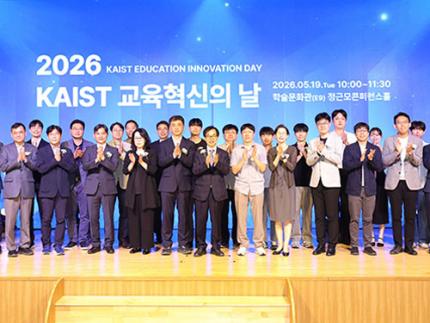
<Photo from the Education Innovation Day event>
KAIST held the “2026 KAIST Education Innovation Day” on May 19 at the Chung Kun Mo Conference Hall in the Academic Culture Complex (E9) on the Daejeon main campus.
Now in its eighth year, the event was organized to recognize faculty members who have contributed to educational innovation and to share outstanding cases within and beyond the university, thereby spreading the value of innovation. The event is supported through a development fund donated by Hyung Gyu Lim, former president of the KAIST Alumni Association.
At this year’s ceremony, Professor Jemin Hwangbo of the Department of Mechanical Engineering received the grand prize of the “Hyung Gyu Lim LINKGENESIS-BEST Teacher Award,” which honors faculty members who have contributed to interdisciplinary education based on KAIST’s core values of creativity, challenge, and consideration. Excellence Awards were presented to Professor Sung Min Kim of the School of Electrical Engineering, Professor Hyun Uk Kim of the Department of Chemical and Biomolecular Engineering, and Professor Yunjae Choi of the Kim Jaechul Graduate School of AI.
Professor Jemin Hwangbo has contributed to advances in robotics by pushing the limits of robot technology through the successful marathon completion of a quadruped robot and by developing reinforcement learning–based control algorithms capable of enabling high-speed locomotion over deformable terrain. He has also devoted himself to cultivating future talent through visualization- and practice-oriented education in dynamics. In recognition of his contributions to creating a virtuous cycle between research and education, he was selected as the recipient of the competition’s highest honor, the grand prize of the “Hyung Gyu Lim LINKGENESIS-BEST Teacher Award.”
<Photo from the Education Innovation Day event>
The grand prize of the “Teaching and Learning Innovation Award,” which recognizes faculty members who have developed learner-centered creative teaching methods and effective pedagogical approaches, was awarded to Professor Donghyuk Shin of the Department of Aerospace Engineering. Excellence Awards in the same category were presented to Professor Sangho Lee of the School of Digital Humanities and Computational Social Sciences, while the team award went to Professors Byungha Shin, Jihun Oh, Seungbeom Hong, and Sung Hoon Kang of the Department of Materials Science and Engineering.
In addition, the “KAIST Educator Award,” which honors faculty members who have fostered students’ autonomous growth, was presented to Professor Jae Hoon Kim of the Department of Biological Sciences and Professor Pil Seung Lee of the Department of Mechanical Engineering. Educational achievements by Professor Hyungsoo Kim, recipient of the Creative Lecture Award, and Professor Beomsoon Park, recipient of the Distinguished Lecture Award, both of whom were honored at the university’s anniversary ceremony in February, were also introduced during the event.
For contributions to strengthening educational competitiveness and internationalization, Professor Soon Sik Kwon of the Department of Mathematical Sciences and 11 other faculty members received the “KAIST Education Innovation Award,” while Professors Miseon Kim and Holly Wang of the School of Digital Humanities and Computational Social Sciences received the “KAIST Education Innovation Contribution Award.”
During the event, Professors Jemin Hwangbo, Pil Seung Lee, Hyungsoo Kim, and Beomsoon Park delivered special lectures sharing innovative educational practices and know-how applied in actual classroom settings. In addition, awards were presented to students who achieved outstanding results in the “2026 KAIST AI Future Challenge,” followed by idea presentation sessions that created opportunities for communication and exchange between students and faculty members.
<Photo from the Education Innovation Day event>
KAIST President Kwang-Hyung Lee stated, “In the era of AI transformation (AX), in which industrial and social structures are being reshaped, cultivating talent capable of leading this transition has become a core mission of universities.” He added, “KAIST will continue to pursue an educational approach centered on encouraging students to ask questions and take on challenges so that they can develop the ability to define and solve problems independently.” He further expressed hope that the event would serve as an opportunity for educational innovation culture to spread throughout the university through the sharing of outstanding field cases and to lead to meaningful industry collaboration.
<Poster for KAIST Education Innovation Day>
2026.05.19 View 629
2026 Education Innovation Day’ Held… Professor Jemin Hwangbo Receives the Grand Prize
<Photo from the Education Innovation Day event>
KAIST held the “2026 KAIST Education Innovation Day” on May 19 at the Chung Kun Mo Conference Hall in the Academic Culture Complex (E9) on the Daejeon main campus.
Now in its eighth year, the event was organized to recognize faculty members who have contributed to educational innovation and to share outstanding cases within and beyond the university, thereby spreading the value of innovation. The event is supported through a development fund donated by Hyung Gyu Lim, former president of the KAIST Alumni Association.
At this year’s ceremony, Professor Jemin Hwangbo of the Department of Mechanical Engineering received the grand prize of the “Hyung Gyu Lim LINKGENESIS-BEST Teacher Award,” which honors faculty members who have contributed to interdisciplinary education based on KAIST’s core values of creativity, challenge, and consideration. Excellence Awards were presented to Professor Sung Min Kim of the School of Electrical Engineering, Professor Hyun Uk Kim of the Department of Chemical and Biomolecular Engineering, and Professor Yunjae Choi of the Kim Jaechul Graduate School of AI.
Professor Jemin Hwangbo has contributed to advances in robotics by pushing the limits of robot technology through the successful marathon completion of a quadruped robot and by developing reinforcement learning–based control algorithms capable of enabling high-speed locomotion over deformable terrain. He has also devoted himself to cultivating future talent through visualization- and practice-oriented education in dynamics. In recognition of his contributions to creating a virtuous cycle between research and education, he was selected as the recipient of the competition’s highest honor, the grand prize of the “Hyung Gyu Lim LINKGENESIS-BEST Teacher Award.”
<Photo from the Education Innovation Day event>
The grand prize of the “Teaching and Learning Innovation Award,” which recognizes faculty members who have developed learner-centered creative teaching methods and effective pedagogical approaches, was awarded to Professor Donghyuk Shin of the Department of Aerospace Engineering. Excellence Awards in the same category were presented to Professor Sangho Lee of the School of Digital Humanities and Computational Social Sciences, while the team award went to Professors Byungha Shin, Jihun Oh, Seungbeom Hong, and Sung Hoon Kang of the Department of Materials Science and Engineering.
In addition, the “KAIST Educator Award,” which honors faculty members who have fostered students’ autonomous growth, was presented to Professor Jae Hoon Kim of the Department of Biological Sciences and Professor Pil Seung Lee of the Department of Mechanical Engineering. Educational achievements by Professor Hyungsoo Kim, recipient of the Creative Lecture Award, and Professor Beomsoon Park, recipient of the Distinguished Lecture Award, both of whom were honored at the university’s anniversary ceremony in February, were also introduced during the event.
For contributions to strengthening educational competitiveness and internationalization, Professor Soon Sik Kwon of the Department of Mathematical Sciences and 11 other faculty members received the “KAIST Education Innovation Award,” while Professors Miseon Kim and Holly Wang of the School of Digital Humanities and Computational Social Sciences received the “KAIST Education Innovation Contribution Award.”
During the event, Professors Jemin Hwangbo, Pil Seung Lee, Hyungsoo Kim, and Beomsoon Park delivered special lectures sharing innovative educational practices and know-how applied in actual classroom settings. In addition, awards were presented to students who achieved outstanding results in the “2026 KAIST AI Future Challenge,” followed by idea presentation sessions that created opportunities for communication and exchange between students and faculty members.
<Photo from the Education Innovation Day event>
KAIST President Kwang-Hyung Lee stated, “In the era of AI transformation (AX), in which industrial and social structures are being reshaped, cultivating talent capable of leading this transition has become a core mission of universities.” He added, “KAIST will continue to pursue an educational approach centered on encouraging students to ask questions and take on challenges so that they can develop the ability to define and solve problems independently.” He further expressed hope that the event would serve as an opportunity for educational innovation culture to spread throughout the university through the sharing of outstanding field cases and to lead to meaningful industry collaboration.
<Poster for KAIST Education Innovation Day>
2026.05.19 View 629 -
 World-Renowned Conductor Han-Na Chang Appointed as Visiting Distinguished Professor
< (From Left) Professor Joo Han Nam, President Kwang Hyung Lee, President and Vice President Students of KAIST Orchestra, Professor Han-Na Chang, Professor Hyeon-Jeong Suk >
"It is very meaningful to be able to share the joy of music with future science and technology leaders at KAIST and to explore the possibilities of a new field of performing arts hand-in-hand with AI." – Han-Na Chang, KAIST Visiting Distinguished Professor
KAIST announced on the 13th of November that it has appointed Han-Na Chang, a world-renowned conductor and musician who was formerly a cellist, as a Visiting Distinguished Professor at the Graduate School of Culture Technology (GSCT).
This appointment was pursued to expand the base of culture and arts within KAIST by inviting a world-class artist, and to lay the foundation for students to grow into creative and converged talents. Furthermore, it is expected to serve as an opportunity to share Professor Chang's experiences of challenge and achievement on the world stage, thereby delivering dreams and inspiration to the members of KAIST. Professor Han-Na Chang will share her 31 years of research as a musician and her stage experience through the 'Orchestra Master Class' (an open practical class where the conductor directly guides student performers on musical interpretation and collaboration through live performance). She will also conduct leadership special lectures for undergraduate and graduate students, sharing her vision for music and her philosophy on a conductor's leadership.
In particular, Professor Chang will participate in advising on Artificial Intelligence (AI) technology necessary for orchestral performance through the Sumi Jo Center for Performing Arts Research at the Graduate School of Culture Technology, thereby suggesting a new research direction that explores the convergence of art and science and technology. The term of appointment is two years, starting from November 2025.
Professor Han-Na Chang stated, "It is very meaningful to be able to share the values of art, leadership, and collaboration with students at KAIST, the center of science and technology," adding, "It is a great joy and honor to contribute to the future science and technology leaders' development of artistic sensibility, creativity, and expressiveness through the joys and sorrows of music.
KAIST President Kwang Hyung Lee remarked, "The joining of Professor Han-Na Chang, who possesses both artistic insight and leadership as a world-renowned conductor, will be a great stimulus to the members of KAIST," and "We expect her to breathe new creative inspiration into the convergence of science and art."
Meanwhile, Professor Han-Na Chang garnered global attention at the age of 11 by winning the First Prize at the Fifth International Rostropovich Cello Competition for the youngest ever. After her career as a cellist on the international stage, she transitioned to conducting in 2007. She is currently recognized for her musical leadership and artistic vision by conducting world-leading orchestras such as the Munich Philharmonic, Orchestre de Paris, Philharmonia Orchestra, and the Royal Concertgebouw Orchestra.
<Professor Han-Na Chang Conducting an Orchestra>
For the reference, KAIST has two orchestras: the 'KAIST Orchestra', which is centered on undergraduate students, and the 'KAIST Art Orchestra', composed of graduate students, faculty, staff, and alumni. The KAIST Orchestra was founded in 1992 and currently has about 90 members. It holds regular concerts every May and November and has established itself as a representative on-campus arts organization voluntarily planned and operated by students. The KAIST Art Orchestra, founded in 2024, is a project-based performance group with approximately 50 members who perform for specific events or projects.
2025.11.13 View 1966
World-Renowned Conductor Han-Na Chang Appointed as Visiting Distinguished Professor
< (From Left) Professor Joo Han Nam, President Kwang Hyung Lee, President and Vice President Students of KAIST Orchestra, Professor Han-Na Chang, Professor Hyeon-Jeong Suk >
"It is very meaningful to be able to share the joy of music with future science and technology leaders at KAIST and to explore the possibilities of a new field of performing arts hand-in-hand with AI." – Han-Na Chang, KAIST Visiting Distinguished Professor
KAIST announced on the 13th of November that it has appointed Han-Na Chang, a world-renowned conductor and musician who was formerly a cellist, as a Visiting Distinguished Professor at the Graduate School of Culture Technology (GSCT).
This appointment was pursued to expand the base of culture and arts within KAIST by inviting a world-class artist, and to lay the foundation for students to grow into creative and converged talents. Furthermore, it is expected to serve as an opportunity to share Professor Chang's experiences of challenge and achievement on the world stage, thereby delivering dreams and inspiration to the members of KAIST. Professor Han-Na Chang will share her 31 years of research as a musician and her stage experience through the 'Orchestra Master Class' (an open practical class where the conductor directly guides student performers on musical interpretation and collaboration through live performance). She will also conduct leadership special lectures for undergraduate and graduate students, sharing her vision for music and her philosophy on a conductor's leadership.
In particular, Professor Chang will participate in advising on Artificial Intelligence (AI) technology necessary for orchestral performance through the Sumi Jo Center for Performing Arts Research at the Graduate School of Culture Technology, thereby suggesting a new research direction that explores the convergence of art and science and technology. The term of appointment is two years, starting from November 2025.
Professor Han-Na Chang stated, "It is very meaningful to be able to share the values of art, leadership, and collaboration with students at KAIST, the center of science and technology," adding, "It is a great joy and honor to contribute to the future science and technology leaders' development of artistic sensibility, creativity, and expressiveness through the joys and sorrows of music.
KAIST President Kwang Hyung Lee remarked, "The joining of Professor Han-Na Chang, who possesses both artistic insight and leadership as a world-renowned conductor, will be a great stimulus to the members of KAIST," and "We expect her to breathe new creative inspiration into the convergence of science and art."
Meanwhile, Professor Han-Na Chang garnered global attention at the age of 11 by winning the First Prize at the Fifth International Rostropovich Cello Competition for the youngest ever. After her career as a cellist on the international stage, she transitioned to conducting in 2007. She is currently recognized for her musical leadership and artistic vision by conducting world-leading orchestras such as the Munich Philharmonic, Orchestre de Paris, Philharmonia Orchestra, and the Royal Concertgebouw Orchestra.
<Professor Han-Na Chang Conducting an Orchestra>
For the reference, KAIST has two orchestras: the 'KAIST Orchestra', which is centered on undergraduate students, and the 'KAIST Art Orchestra', composed of graduate students, faculty, staff, and alumni. The KAIST Orchestra was founded in 1992 and currently has about 90 members. It holds regular concerts every May and November and has established itself as a representative on-campus arts organization voluntarily planned and operated by students. The KAIST Art Orchestra, founded in 2024, is a project-based performance group with approximately 50 members who perform for specific events or projects.
2025.11.13 View 1966 -
 IEEE President Professor Kramer Holds Special Lecture on Artificial Intelligence in the Electrical Engineering Department
Kathleen A. Kramer, President of the IEEE (Institute of Electrical and Electronics Engineers), the world's largest technical professional organization dedicated to electrical and electronic technology, visited our university on the 30th and delivered a special lecture under the theme, 'Drawing the Future of Artificial Intelligence Together.'
< IEEE Leadership and KAIST EE Meeting KITIS Director (Sung-Hyun Hong), KAIST EE Professors (Joonwoo Bae), (Ian Oakley), (Hye-Won Jeong), (Chang-Shik Choi), (Dong-Soo Han), Head of EE Department (Seunghyup Yoo), IEEE President (Kathleen A. Kramer), IEEE Senior Sales Director (Francis Staples), IEEE Regional Manager for APAC (Ira Tan), KAIST EE Professor (Hee-Jin Ahn), Head of Semiconductor System Engineering Department (Sung-Hwan Cho)>
Standing at the colloquium podium by invitation of the Department of Electrical Engineering (Head: Seung-Hyup Yoo), President Kramer emphasized based on IEEE's core vision, 'Advancing Technology for Humanity,' that "Artificial Intelligence (AI) is no longer a concept of the distant future; it has become a technology that is transforming human lives at the center of innovation."
< Photo of IEEE President's KAIST EE Colloquium Lecture >
She further added, "Technology must advance with human values at its core, and AI based on ethics and inclusiveness can lead to true innovation," sharing her insights on the direction of AI development and the social responsibility of technology.
Seung-Hyup Yoo, Head of the Department of Electrical Engineering, stated, "We expect President Kramer's visit to be a stepping stone that will not only widely promote our department's capabilities in advanced fields such as AI, semiconductors, signal processing, and robotics to the international academic community but also strengthen cooperation in various ways."
< Tea Meeting with the IEEE Leadership and the Vice Presidents . KITIS Director (Sung-Hyun Hong), IEEE Senior Sales Director (Francis Staples), IEEE President (Kathleen A. Kramer), KAIST Executive Vice President for Research (Sang Yup Lee), Head of EE Department (Seunghyup Yoo), IEEE Regional Manager for APAC (Ira Tan)>
Meanwhile, prior to the lecture, President Kramer paid a courtesy visit to Sang-Yup Lee, KAIST Executive Vice President for Research, and reaffirmed the commitment of both organizations to advancing sustainable technology and building an ethical and inclusive research ecosystem to contribute to a better life for humanity.
2025.11.06 View 2081
IEEE President Professor Kramer Holds Special Lecture on Artificial Intelligence in the Electrical Engineering Department
Kathleen A. Kramer, President of the IEEE (Institute of Electrical and Electronics Engineers), the world's largest technical professional organization dedicated to electrical and electronic technology, visited our university on the 30th and delivered a special lecture under the theme, 'Drawing the Future of Artificial Intelligence Together.'
< IEEE Leadership and KAIST EE Meeting KITIS Director (Sung-Hyun Hong), KAIST EE Professors (Joonwoo Bae), (Ian Oakley), (Hye-Won Jeong), (Chang-Shik Choi), (Dong-Soo Han), Head of EE Department (Seunghyup Yoo), IEEE President (Kathleen A. Kramer), IEEE Senior Sales Director (Francis Staples), IEEE Regional Manager for APAC (Ira Tan), KAIST EE Professor (Hee-Jin Ahn), Head of Semiconductor System Engineering Department (Sung-Hwan Cho)>
Standing at the colloquium podium by invitation of the Department of Electrical Engineering (Head: Seung-Hyup Yoo), President Kramer emphasized based on IEEE's core vision, 'Advancing Technology for Humanity,' that "Artificial Intelligence (AI) is no longer a concept of the distant future; it has become a technology that is transforming human lives at the center of innovation."
< Photo of IEEE President's KAIST EE Colloquium Lecture >
She further added, "Technology must advance with human values at its core, and AI based on ethics and inclusiveness can lead to true innovation," sharing her insights on the direction of AI development and the social responsibility of technology.
Seung-Hyup Yoo, Head of the Department of Electrical Engineering, stated, "We expect President Kramer's visit to be a stepping stone that will not only widely promote our department's capabilities in advanced fields such as AI, semiconductors, signal processing, and robotics to the international academic community but also strengthen cooperation in various ways."
< Tea Meeting with the IEEE Leadership and the Vice Presidents . KITIS Director (Sung-Hyun Hong), IEEE Senior Sales Director (Francis Staples), IEEE President (Kathleen A. Kramer), KAIST Executive Vice President for Research (Sang Yup Lee), Head of EE Department (Seunghyup Yoo), IEEE Regional Manager for APAC (Ira Tan)>
Meanwhile, prior to the lecture, President Kramer paid a courtesy visit to Sang-Yup Lee, KAIST Executive Vice President for Research, and reaffirmed the commitment of both organizations to advancing sustainable technology and building an ethical and inclusive research ecosystem to contribute to a better life for humanity.
2025.11.06 View 2081 -
 "KAIST Opens Up! Cutting-Edge Research Sites Revealed... 'OPEN KAIST 2025' to be Held
< 2025 OPEN KAIST Poster >
KAIST announced on the 23rd of October that it will hold the 'OPEN KAIST 2025' event, which publicly opens research labs, experiment rooms, and research centers on campus, for two days starting from October 30th at the main campus in Daejeon.
OPEN KAIST, which began in 2001 and marks its 13th event this year, is a representative research exhibition event operated biennially by the KAIST College of Engineering (Dean Jae Woo Lee), aiming for programs where citizens can directly experience the research environment and encounter science more closely.
This year, 16 departments and the KAIST Satellite Technology Research Center are participating, operating a total of 39 programs across five areas: △Experience/Demonstration △Lab Tour △Lecture △Department Introduction △Achievement Exhibition. In particular, the opportunities to directly observe and learn about core future fields such as AI, drones, brain science, nuclear energy, and semiconductors have been greatly enhanced.
Professor Jun Han's lab in the School of Computing will introduce technology where AI understands 3D space and constructs virtual environments. Participants will confirm the process of objects in a video being rearranged through a demonstration and learn about the role of AI in future society and the direction of development for spatial perception technology.
Professor Hyochoong Bang's lab in the Department of Aerospace Engineering will unveil next-generation drone technologies, including multicopters, unmanned helicopters, and Vertical Take-Off and Landing (VTOL) aircraft. Participants will understand their characteristics and usage environments, observe the already flight-tested technologies up close, and get a panoramic view of the changes the drone industry will bring.
Professor Minee Choi's lab in the Department of Brain and Cognitive Sciences offers an opportunity to experience the relationship between the brain and behavior. Participants will use an online application to create their own mini-brain, virtually examine the effects of exercise or vitamin intake on the brain, and directly experience research equipment and the experimental environment.
The Department of Mathematical Sciences has prepared two special lectures for youth. The lecture ‘Secrets Hidden in the Growth Data Patterns of Mammals’ will explore universal mathematical rules within the growth data of various mammals, from the American shrew mole weighing barely 10g to the blue whale exceeding 200 tons. The subsequent lecture, ‘Can This Knot Really Be Undone? — A Mathematical Way to Understand Space’, will explain the mathematical thought process for understanding space, using everyday knots like shoelaces as examples, tailored to the youth's level.
The Department of Nuclear and Quantum Engineering program includes radiation detection practice and a look at the potential utilization of next-generation nuclear technologies such as SMRs and microreactors. The Department of Industrial Design will introduce how design research connects to solving real-life problems through lab tours and exhibitions.
The Semiconductor Research Facility Tour allows participants to directly enter a cleanroom to observe the process equipment and manufacturing stages, experiencing the completion process of ultrafine semiconductors.
In addition, a variety of other programs are prepared, including a lecture by Professor Hyungjun Kim of the Moon Soul Graduate School of Future Strategy titled ‘Meta-Earth: Climate Crisis and Earth's Changes through Data’, the Department of Civil and Environmental Engineering’s ‘Centrifuge Modeling Test: Earthquake Research using Centrifugal Force’, and a game development special lecture and exhibition by the School of Computing's game production club 'Haze'.
< OPEN KAIST Event Scene >
Jae Woo Lee, Dean of the College of Engineering, stated, "We prepared this event to open up KAIST's education and research sites and provide visitors with an opportunity to directly experience and communicate about challenging and creative science and technology innovation."
KAIST President Kwang Hyung Lee said, "OPEN KAIST is a meaningful occasion to share the research environment with the public," and "I hope this event serves as an opportunity for youth and citizens to feel the value of science and foster dreams of future challenges."
For individual visitors, 'OPEN KAIST 2025' can be freely viewed according to the on-site situation by referring to the booklet distributed at the information desk on the day of the event, without prior application. Detailed schedules and programs can be checked on the website (https://openkaist.ac.kr).**
2025.10.23 View 3950
"KAIST Opens Up! Cutting-Edge Research Sites Revealed... 'OPEN KAIST 2025' to be Held
< 2025 OPEN KAIST Poster >
KAIST announced on the 23rd of October that it will hold the 'OPEN KAIST 2025' event, which publicly opens research labs, experiment rooms, and research centers on campus, for two days starting from October 30th at the main campus in Daejeon.
OPEN KAIST, which began in 2001 and marks its 13th event this year, is a representative research exhibition event operated biennially by the KAIST College of Engineering (Dean Jae Woo Lee), aiming for programs where citizens can directly experience the research environment and encounter science more closely.
This year, 16 departments and the KAIST Satellite Technology Research Center are participating, operating a total of 39 programs across five areas: △Experience/Demonstration △Lab Tour △Lecture △Department Introduction △Achievement Exhibition. In particular, the opportunities to directly observe and learn about core future fields such as AI, drones, brain science, nuclear energy, and semiconductors have been greatly enhanced.
Professor Jun Han's lab in the School of Computing will introduce technology where AI understands 3D space and constructs virtual environments. Participants will confirm the process of objects in a video being rearranged through a demonstration and learn about the role of AI in future society and the direction of development for spatial perception technology.
Professor Hyochoong Bang's lab in the Department of Aerospace Engineering will unveil next-generation drone technologies, including multicopters, unmanned helicopters, and Vertical Take-Off and Landing (VTOL) aircraft. Participants will understand their characteristics and usage environments, observe the already flight-tested technologies up close, and get a panoramic view of the changes the drone industry will bring.
Professor Minee Choi's lab in the Department of Brain and Cognitive Sciences offers an opportunity to experience the relationship between the brain and behavior. Participants will use an online application to create their own mini-brain, virtually examine the effects of exercise or vitamin intake on the brain, and directly experience research equipment and the experimental environment.
The Department of Mathematical Sciences has prepared two special lectures for youth. The lecture ‘Secrets Hidden in the Growth Data Patterns of Mammals’ will explore universal mathematical rules within the growth data of various mammals, from the American shrew mole weighing barely 10g to the blue whale exceeding 200 tons. The subsequent lecture, ‘Can This Knot Really Be Undone? — A Mathematical Way to Understand Space’, will explain the mathematical thought process for understanding space, using everyday knots like shoelaces as examples, tailored to the youth's level.
The Department of Nuclear and Quantum Engineering program includes radiation detection practice and a look at the potential utilization of next-generation nuclear technologies such as SMRs and microreactors. The Department of Industrial Design will introduce how design research connects to solving real-life problems through lab tours and exhibitions.
The Semiconductor Research Facility Tour allows participants to directly enter a cleanroom to observe the process equipment and manufacturing stages, experiencing the completion process of ultrafine semiconductors.
In addition, a variety of other programs are prepared, including a lecture by Professor Hyungjun Kim of the Moon Soul Graduate School of Future Strategy titled ‘Meta-Earth: Climate Crisis and Earth's Changes through Data’, the Department of Civil and Environmental Engineering’s ‘Centrifuge Modeling Test: Earthquake Research using Centrifugal Force’, and a game development special lecture and exhibition by the School of Computing's game production club 'Haze'.
< OPEN KAIST Event Scene >
Jae Woo Lee, Dean of the College of Engineering, stated, "We prepared this event to open up KAIST's education and research sites and provide visitors with an opportunity to directly experience and communicate about challenging and creative science and technology innovation."
KAIST President Kwang Hyung Lee said, "OPEN KAIST is a meaningful occasion to share the research environment with the public," and "I hope this event serves as an opportunity for youth and citizens to feel the value of science and foster dreams of future challenges."
For individual visitors, 'OPEN KAIST 2025' can be freely viewed according to the on-site situation by referring to the booklet distributed at the information desk on the day of the event, without prior application. Detailed schedules and programs can be checked on the website (https://openkaist.ac.kr).**
2025.10.23 View 3950 -
 The Secret of Our Success Author Joseph Henrich to Deliver Special Lecture at KAIST
KAIST announced on the 19th that its Institute for Mind and Brain Sciences and the Department of Brain and Cognitive Science will be hosting a special lecture by world-renowned cultural evolution scholar, Professor Joseph Henrich of Harvard University. The free lecture will take place on the 22nd at the Conference Room on the 1st floor of the Meta-Convergence Hall at the KAIST main campus, with support from the Gikwan Foundation. The event is open to the public.
Professor Henrich, a professor in the Department of Human Evolutionary Biology at Harvard, is a leading authority on the evolution of culture and cooperation. He was recognized for his work on the origins of human cooperative behavior through a comparative study of 15 small-scale societies, earning the 2024 Panmure House Prize* (Adam Smith 300th Anniversary Prize) and the 2022 Hayek Book Prize.
* Panmure House Prize: An academic award established in honor of Adam Smith's scholarship, named after the building where he lived.
< Poster for Special Lecture by Professor Joseph Henrich of Harvard University >
His representative books, "The WEIRDest People in the World" and "The Secret of Our Success," have created a significant stir in both academia and the general public by offering new interpretations of the formation and development of human society from a cultural evolution perspective.
"The WEIRDest People in the World" emphasizes that human thought and behavior are products of specific cultural environments rather than universal truths. "The Secret of Our Success" presents a new perspective on how humanity, through cultural artifacts like language, tools, and institutions, has achieved unique success compared to other animals.
The lecture will be divided into two sessions: an academic seminar and a public lecture. The academic seminar, held from 10:00 AM to 11:30 AM, will be conducted in English on the topic of "Cultural Evolutionary Psychology, Kinship, and the Historical Origins of Modern Psychological Differences." It is intended for researchers, graduate students, and undergraduate students in related fields.
Following this, a public lecture will be held from 3:00 PM to 5:00 PM on the topic of "The Collective Brain: Social and Cultural Origins of Creativity." Professor Jeong Jae-seung of KAIST's Department of Brain and Cognitive Science will serve as the moderator, and simultaneous interpretation will be provided.
The lecture will cover how innovation and creativity are products of a collective intelligence formed by diverse people exchanging ideas through networks. It will also discuss how the pace of innovation within a population is determined by key factors such as community size, social connectivity, and cognitive diversity, and how these principles explain innovation in various social contexts, including cultural psychology, immigration, urbanization, and institutions. There will also be a Q&A session with the author of "The Secret of Our Success."
Regarding the lecture, Professor Henrich stated, "In human evolution, culture is not just a backdrop; it's the core driving force that makes us human. Through this lecture, I want to share how we have learned from each other, cooperated, and developed knowledge and institutions. I especially look forward to having a deep conversation with the audience about the evolutionary significance of the passion for education and learning culture in Korean society."
Professor Jeong Jae-seung of KAIST's Department of Brain and Cognitive Science said, "This lecture was organized to explore how the human mind and brain have evolved through interaction with culture. It will be a valuable opportunity to hear the insights of a world-renowned scholar from the interdisciplinary perspective of meditation science and brain and cognitive science."
To register for the event, you can use the link (https://forms.gle/7TW9FAKv1qgA3dBBA) or the QR code on the poster. For inquiries, please contact the KAIST Institute for Mind and Brain Sciences at 042-350-1361.
2025.09.19 View 2403
The Secret of Our Success Author Joseph Henrich to Deliver Special Lecture at KAIST
KAIST announced on the 19th that its Institute for Mind and Brain Sciences and the Department of Brain and Cognitive Science will be hosting a special lecture by world-renowned cultural evolution scholar, Professor Joseph Henrich of Harvard University. The free lecture will take place on the 22nd at the Conference Room on the 1st floor of the Meta-Convergence Hall at the KAIST main campus, with support from the Gikwan Foundation. The event is open to the public.
Professor Henrich, a professor in the Department of Human Evolutionary Biology at Harvard, is a leading authority on the evolution of culture and cooperation. He was recognized for his work on the origins of human cooperative behavior through a comparative study of 15 small-scale societies, earning the 2024 Panmure House Prize* (Adam Smith 300th Anniversary Prize) and the 2022 Hayek Book Prize.
* Panmure House Prize: An academic award established in honor of Adam Smith's scholarship, named after the building where he lived.
< Poster for Special Lecture by Professor Joseph Henrich of Harvard University >
His representative books, "The WEIRDest People in the World" and "The Secret of Our Success," have created a significant stir in both academia and the general public by offering new interpretations of the formation and development of human society from a cultural evolution perspective.
"The WEIRDest People in the World" emphasizes that human thought and behavior are products of specific cultural environments rather than universal truths. "The Secret of Our Success" presents a new perspective on how humanity, through cultural artifacts like language, tools, and institutions, has achieved unique success compared to other animals.
The lecture will be divided into two sessions: an academic seminar and a public lecture. The academic seminar, held from 10:00 AM to 11:30 AM, will be conducted in English on the topic of "Cultural Evolutionary Psychology, Kinship, and the Historical Origins of Modern Psychological Differences." It is intended for researchers, graduate students, and undergraduate students in related fields.
Following this, a public lecture will be held from 3:00 PM to 5:00 PM on the topic of "The Collective Brain: Social and Cultural Origins of Creativity." Professor Jeong Jae-seung of KAIST's Department of Brain and Cognitive Science will serve as the moderator, and simultaneous interpretation will be provided.
The lecture will cover how innovation and creativity are products of a collective intelligence formed by diverse people exchanging ideas through networks. It will also discuss how the pace of innovation within a population is determined by key factors such as community size, social connectivity, and cognitive diversity, and how these principles explain innovation in various social contexts, including cultural psychology, immigration, urbanization, and institutions. There will also be a Q&A session with the author of "The Secret of Our Success."
Regarding the lecture, Professor Henrich stated, "In human evolution, culture is not just a backdrop; it's the core driving force that makes us human. Through this lecture, I want to share how we have learned from each other, cooperated, and developed knowledge and institutions. I especially look forward to having a deep conversation with the audience about the evolutionary significance of the passion for education and learning culture in Korean society."
Professor Jeong Jae-seung of KAIST's Department of Brain and Cognitive Science said, "This lecture was organized to explore how the human mind and brain have evolved through interaction with culture. It will be a valuable opportunity to hear the insights of a world-renowned scholar from the interdisciplinary perspective of meditation science and brain and cognitive science."
To register for the event, you can use the link (https://forms.gle/7TW9FAKv1qgA3dBBA) or the QR code on the poster. For inquiries, please contact the KAIST Institute for Mind and Brain Sciences at 042-350-1361.
2025.09.19 View 2403 -
 KAIST–National Intelligence Service Successfully Hold the 4th University Research Security Education Council Workshop
KAIST (President Kwang Hyung Lee) announced on the 22nd of August that, together with the National Intelligence Service, it held the “4th University Research Security Education Council Workshop” at the Academic Cultural Complex on KAIST’s main campus in Daejeon on the 21st.
This 4th workshop was held under the theme of “Global Research Security,” based on the recognition that technology leakage can have serious impacts not only on the national economy and security but on international exchanges in science and technology. Accordingly, national policies and outstanding cases from institutions to enhance the level of university research security management were shared, and practical security enhancement measures applicable in the field were discussed.
In the presentation sessions, △ the Ministry of Science and ICT presented the government’s policy direction for strengthening research security, △ the National Institute for International Education and Training (KIRD) gave a presentation on settlement and career support programs for foreign researchers in science and engineering, △ the Korea Strategic Trade Institute (KOSTI) introduced the Authorized Economic Operator (AEO/CP) system for universities’ dual-use items and technology export control measures, and △ the Korea Institute of S&T Evaluation and Planning (KISTEP) conducted a special lecture on research security field manuals.
In the university case presentations, KAIST shared achievements in promoting global research security, while Yong In University introduced its newly launched program this year for fostering security professionals.
This event was attended by more than 130 participants from approximately 70 universities nationwide, including Seoul National University and Ewha Womans University, as well as officials from the Ministry of Science and ICT, the National Intelligence Service, KIRD, KISTEP, and KOSTI.
An NIS official stated, “With the rapid changes in the university research environment due to the expansion of international joint research and the increase in international students, the establishment of a research security culture has become more important than ever. Based on the excellent cases shared at the workshop, we will actively reflect the opinions of host institutions to spread security awareness and continue preparing effective countermeasures.”
Cheol Seong Jang, President of the National University Council of Research & Industry Cooperation and Research Directors (Professor at Kangwon National University), emphasized, “If the ideas and cases discussed at the workshop are applied in university settings, they will greatly contribute to Korea leading the establishment of a trusted global research ecosystem.”
Byung-Kwan Cho, Director of Research at KAIST, said, “KAIST will not hesitate to introduce and spread leading research security systems so that our efforts to strengthen research security become a benchmark for other universities. By applying the principle of open science — ‘as open as possible, as closed as necessary’ — we will ensure that research security and global exchanges achieve harmony.”
The University Research Security Education Council was launched in June 2022 with joint supervision by KAIST and the National Intelligence Service and cooperation from KIRD. This year’s workshop was co-hosted by KAIST, the National Intelligence Service, and Kangwon National University.
2025.08.22 View 2968
KAIST–National Intelligence Service Successfully Hold the 4th University Research Security Education Council Workshop
KAIST (President Kwang Hyung Lee) announced on the 22nd of August that, together with the National Intelligence Service, it held the “4th University Research Security Education Council Workshop” at the Academic Cultural Complex on KAIST’s main campus in Daejeon on the 21st.
This 4th workshop was held under the theme of “Global Research Security,” based on the recognition that technology leakage can have serious impacts not only on the national economy and security but on international exchanges in science and technology. Accordingly, national policies and outstanding cases from institutions to enhance the level of university research security management were shared, and practical security enhancement measures applicable in the field were discussed.
In the presentation sessions, △ the Ministry of Science and ICT presented the government’s policy direction for strengthening research security, △ the National Institute for International Education and Training (KIRD) gave a presentation on settlement and career support programs for foreign researchers in science and engineering, △ the Korea Strategic Trade Institute (KOSTI) introduced the Authorized Economic Operator (AEO/CP) system for universities’ dual-use items and technology export control measures, and △ the Korea Institute of S&T Evaluation and Planning (KISTEP) conducted a special lecture on research security field manuals.
In the university case presentations, KAIST shared achievements in promoting global research security, while Yong In University introduced its newly launched program this year for fostering security professionals.
This event was attended by more than 130 participants from approximately 70 universities nationwide, including Seoul National University and Ewha Womans University, as well as officials from the Ministry of Science and ICT, the National Intelligence Service, KIRD, KISTEP, and KOSTI.
An NIS official stated, “With the rapid changes in the university research environment due to the expansion of international joint research and the increase in international students, the establishment of a research security culture has become more important than ever. Based on the excellent cases shared at the workshop, we will actively reflect the opinions of host institutions to spread security awareness and continue preparing effective countermeasures.”
Cheol Seong Jang, President of the National University Council of Research & Industry Cooperation and Research Directors (Professor at Kangwon National University), emphasized, “If the ideas and cases discussed at the workshop are applied in university settings, they will greatly contribute to Korea leading the establishment of a trusted global research ecosystem.”
Byung-Kwan Cho, Director of Research at KAIST, said, “KAIST will not hesitate to introduce and spread leading research security systems so that our efforts to strengthen research security become a benchmark for other universities. By applying the principle of open science — ‘as open as possible, as closed as necessary’ — we will ensure that research security and global exchanges achieve harmony.”
The University Research Security Education Council was launched in June 2022 with joint supervision by KAIST and the National Intelligence Service and cooperation from KIRD. This year’s workshop was co-hosted by KAIST, the National Intelligence Service, and Kangwon National University.
2025.08.22 View 2968 -
 2025 APEC Youth STEM Science Exchange Program Successfully Completed
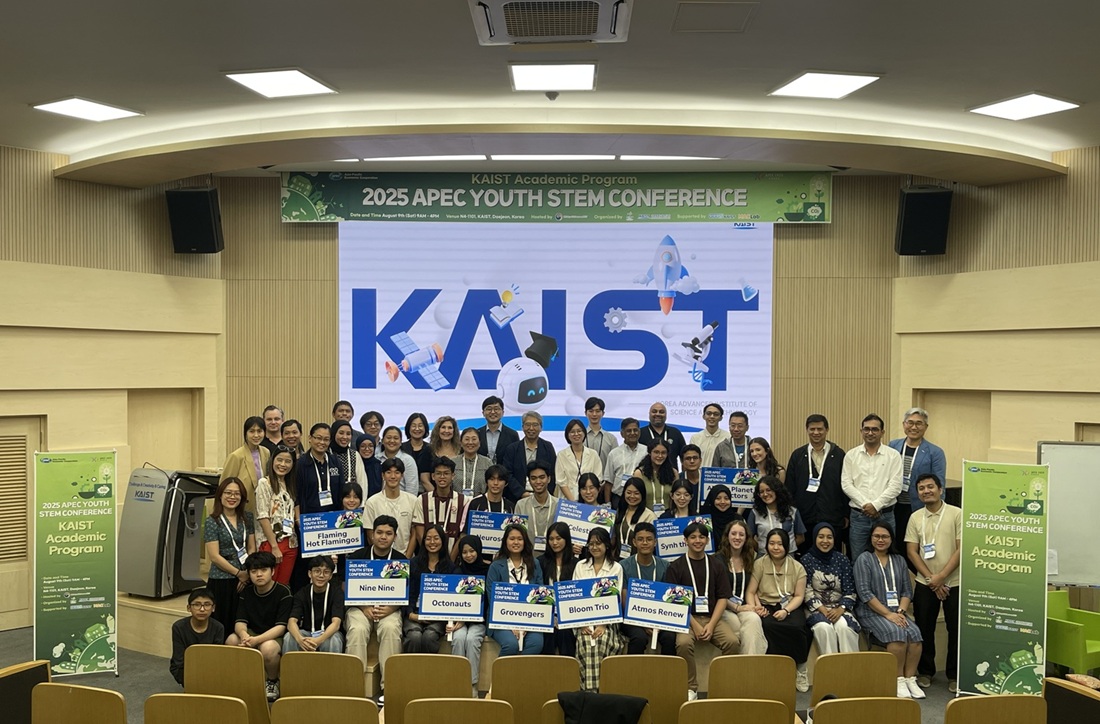
<Photo1. Group photo at the end of the program>
KAIST (President Kwang Hyung Lee) announced on the 11thof August that it successfully hosted the 'APEC Youth STEM Conference KAIST Academic Program,' a global science exchange program for 28 youth researchers from 10 countries and over 30 experts who participated in the '2025 APEC Youth STEM* Collaborative Research and Competition.' The event was held at the main campus in Daejeon on Saturday, August 9.
STEM (Science, Technology, Engineering, Math) refers to the fields of science and engineering.
The competition was hosted by the Ministry of Science and ICT and organized by the APEC Science Gifted Mentoring Center. It took place from Wednesday, August 6, to Saturday, August 9, 2025, at KAIST in Daejeon and the Korea Science Academy of KAIST in Busan. The KAIST program was organized by the APEC Science Gifted Mentoring Center and supported by the KAIST Institute for the Gifted and Talented in Science Education.
Participants had the opportunity to experience Korea's cutting-edge research infrastructure firsthand, broaden their horizons in science and technology, and collaborate and exchange ideas with future science talents from the APEC region.
As the 2025 APEC chair, Korea is promoting various international collaborations to discover and nurture the next generation of talent in the STEM fields. The KAIST academic exchange program was particularly meaningful as it was designed with the international goal of revitalizing science gifted exchanges and expanding the basis for cooperation among APEC member countries. It moved beyond the traditional online-centric research collaboration model to focus on hands-on, on-site, and convergence research experiences.
The global science exchange program at KAIST introduced participants to KAIST's world-class educational and research environment and provided various academic content to allow them to experience real-world examples of convergence technology-based research.
<Photo2. Program Activities>
First, the KAIST Admissions Office participated, introducing KAIST's admissions system and its educational and research environment to outstanding international students, providing an opportunity to attract global talent. Following this, Dr. Tae-kyun Kwon of the Music and Audio Computing Lab at the Graduate School of Culture Technology presented a convergence art project based on musical artificial intelligence data, including a research demonstration in an anechoic chamber.
<Photo3. Participation in a music AI research demonstration>
Furthermore, a Climate Talk Concert program was organized under the leadership of the Graduate School of Green Growth and Sustainability, in connection with the theme of the APEC Youth STEM Collaborative Research: 'Youth-led STEM Solutions: Enhancing Climate Resilience.'
The program was planned and hosted by Dean Jiyong Eom. It provided a platform for young people to explore creative and practical STEM-based solutions to the climate crisis and seek opportunities for international cooperation.
<Photo4. Participation in Music AI Research Demonstration >
The program was a meaningful time for APEC youth researchers, offering practical support for their research through special lectures and Q&A sessions on:
Interdisciplinary Research and Education in the Era of Climate Crisis (Dean Jiyong Eom)
Energy Transition Technology in the Carbon Neutral Era (Professor Jeongrak Son)
Policies for Energy System Change (Professor Jihyo Kim)
Carbon Neutral Bio-technology (Professor Gyeongrok Choi)
After the afternoon talk concert, Lee Jing Jing, a student from Brunei, shared her thoughts, saying, "The lectures by the four professors were very meaningful and insightful. I was able to think about energy transition plans to solve climate change from various perspectives."
Si-jong Kwak, Director of the KAIST Global Institute for Talented Education, stated, "I hope that young people from all over the world will directly experience KAIST's research areas and environment, expand their interest in KAIST, and continue to grow as outstanding talents in the fields of science and engineering."
KAIST President Kwang Hyung Lee said, "KAIST will be at the center of science and technology-based international cooperation and will spare no effort to support future talents in developing creative and practical problem-solving skills. I hope this event served as an opportunity for young people to understand the value of global cooperation and grow into future science leaders."
2025.08.11 View 6356
2025 APEC Youth STEM Science Exchange Program Successfully Completed
<Photo1. Group photo at the end of the program>
KAIST (President Kwang Hyung Lee) announced on the 11thof August that it successfully hosted the 'APEC Youth STEM Conference KAIST Academic Program,' a global science exchange program for 28 youth researchers from 10 countries and over 30 experts who participated in the '2025 APEC Youth STEM* Collaborative Research and Competition.' The event was held at the main campus in Daejeon on Saturday, August 9.
STEM (Science, Technology, Engineering, Math) refers to the fields of science and engineering.
The competition was hosted by the Ministry of Science and ICT and organized by the APEC Science Gifted Mentoring Center. It took place from Wednesday, August 6, to Saturday, August 9, 2025, at KAIST in Daejeon and the Korea Science Academy of KAIST in Busan. The KAIST program was organized by the APEC Science Gifted Mentoring Center and supported by the KAIST Institute for the Gifted and Talented in Science Education.
Participants had the opportunity to experience Korea's cutting-edge research infrastructure firsthand, broaden their horizons in science and technology, and collaborate and exchange ideas with future science talents from the APEC region.
As the 2025 APEC chair, Korea is promoting various international collaborations to discover and nurture the next generation of talent in the STEM fields. The KAIST academic exchange program was particularly meaningful as it was designed with the international goal of revitalizing science gifted exchanges and expanding the basis for cooperation among APEC member countries. It moved beyond the traditional online-centric research collaboration model to focus on hands-on, on-site, and convergence research experiences.
The global science exchange program at KAIST introduced participants to KAIST's world-class educational and research environment and provided various academic content to allow them to experience real-world examples of convergence technology-based research.
<Photo2. Program Activities>
First, the KAIST Admissions Office participated, introducing KAIST's admissions system and its educational and research environment to outstanding international students, providing an opportunity to attract global talent. Following this, Dr. Tae-kyun Kwon of the Music and Audio Computing Lab at the Graduate School of Culture Technology presented a convergence art project based on musical artificial intelligence data, including a research demonstration in an anechoic chamber.
<Photo3. Participation in a music AI research demonstration>
Furthermore, a Climate Talk Concert program was organized under the leadership of the Graduate School of Green Growth and Sustainability, in connection with the theme of the APEC Youth STEM Collaborative Research: 'Youth-led STEM Solutions: Enhancing Climate Resilience.'
The program was planned and hosted by Dean Jiyong Eom. It provided a platform for young people to explore creative and practical STEM-based solutions to the climate crisis and seek opportunities for international cooperation.
<Photo4. Participation in Music AI Research Demonstration >
The program was a meaningful time for APEC youth researchers, offering practical support for their research through special lectures and Q&A sessions on:
Interdisciplinary Research and Education in the Era of Climate Crisis (Dean Jiyong Eom)
Energy Transition Technology in the Carbon Neutral Era (Professor Jeongrak Son)
Policies for Energy System Change (Professor Jihyo Kim)
Carbon Neutral Bio-technology (Professor Gyeongrok Choi)
After the afternoon talk concert, Lee Jing Jing, a student from Brunei, shared her thoughts, saying, "The lectures by the four professors were very meaningful and insightful. I was able to think about energy transition plans to solve climate change from various perspectives."
Si-jong Kwak, Director of the KAIST Global Institute for Talented Education, stated, "I hope that young people from all over the world will directly experience KAIST's research areas and environment, expand their interest in KAIST, and continue to grow as outstanding talents in the fields of science and engineering."
KAIST President Kwang Hyung Lee said, "KAIST will be at the center of science and technology-based international cooperation and will spare no effort to support future talents in developing creative and practical problem-solving skills. I hope this event served as an opportunity for young people to understand the value of global cooperation and grow into future science leaders."
2025.08.11 View 6356 -
 KAIST Holds '2025 KAIST Science Frontier Camp' for Multicultural Youth
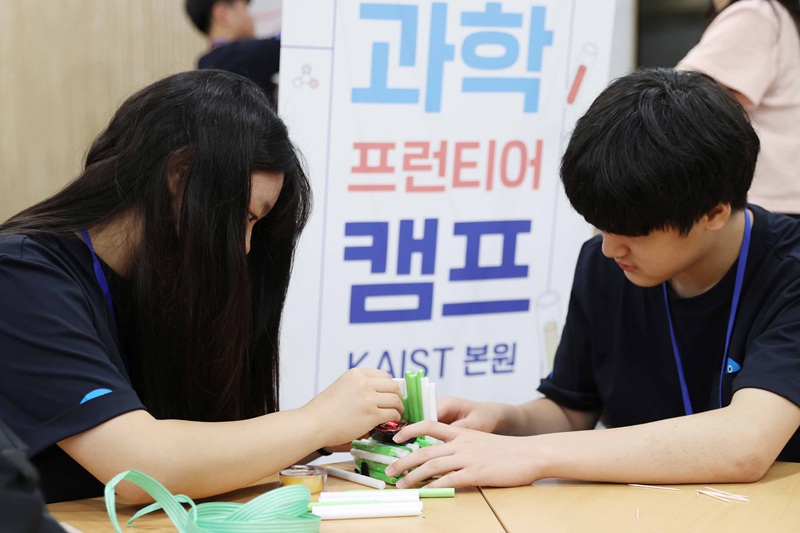
<2025 KAIST Science Frontier Camp Activities>
KAIST (President Kwang Hyung Lee) announced on the 18th of July that it hosted the '2025 KAIST Science Frontier Camp' for multicultural youth from the 15th for three days and two nights at the Creative Learning Building on its main campus in Daejeon.
This event was organized in accordance with the 'Multicultural Talent Nurturing Agreement' signed by KAIST and GS Caltex in 2024. It marks the first year of a mid-to-long-term project in which 100 million KRW in development funds will be contributed annually for four years. The Global Institute for Talented Education organized the camp, and approximately 30 middle school students from multicultural families affiliated with the 'Hanmaum Educational Volunteer Group' (Director, Honorary Professor Byung Kyu Choi), a mentoring and volunteer organization for multicultural students, participated.
The camp participants enjoyed developing their scientific thinking skills and problem-solving abilities, and broadening their understanding of STEM (Science, Technology, Engineering, and Mathematics) career paths through a variety of science activity programs, including: △'Black Box: Record the Egg's Last Moment!' △'Find the Best Strategy! Heuristic Algorithm Challenge' △'Future Society and AI, Finding Career Directions' △'Distance Dominates the World!' and △'Career Talk Concert.'
During the opening ceremony, Director Byung Kyu Choi delivered a congratulatory speech. Additionally, Yong Hyun Kim, Dean of Admissions at KAIST, gave a special lecture titled 'La La Land KAIST – A Story of Chasing the Dream of a Young Scientist,' sharing honest stories about careers and dreams as a scientist.
Gi Jung Yoo, a freshman from the Division of Undeclared Majors who participated in the camp as a student mentor, shared that he had a very meaningful time mentoring the participating students, who are future STEM hopefuls, sharing vivid experiences as well as insights on metric functions. He added his hope that more students would be given such opportunities.
< Students Actively Taking Part in the Camp Activities>
Si Jong Kwak, Director of the Global Institute for Talented Education, stated, "We hope this will be a practical way to help students foster their interest in science, learn the joy of discussion and communication, and design their future."
KAIST President Kwang Hyung Lee remarked, "This camp was a valuable opportunity for students from diverse cultural backgrounds to gain confidence through science and envision their future." He added, "KAIST will continue to dedicate efforts to nurturing multicultural talent and contribute to creating a sustainable society."
Since 2024, KAIST has introduced and selected multicultural students through its Equal Opportunity Admission track. Utilizing the development funds from GS Caltex, KAIST also established the 'GS Caltex Multicultural Excellence Scholarship Program.' Through this scholarship program, undergraduate students from multicultural families receive living expenses each semester, allowing them to focus more stably on their studies. As the number of applicants for the Equal Opportunity Admission track is increasing every year, more multicultural students are expected to benefit from scholarships in the future.
Additionally, in May, both organizations invited Ms. Si Si Wu Fong, a foreign employee at GS Caltex, to give a special lecture titled 'Working Life for Foreigners in Korea' to support foreign students' career exploration. Foreign students who attended the lecture reported positive feedback, stating that they gained practical career information and were motivated to pursue employment in STEM fields in Korea.
KAIST plans to continue strengthening its efforts to nurture multicultural talent, increase understanding of the upcoming multicultural society, and help spread social values.
<At the 2025 KAIST Science Frontier Camp>
2025.07.18 View 4038
KAIST Holds '2025 KAIST Science Frontier Camp' for Multicultural Youth
<2025 KAIST Science Frontier Camp Activities>
KAIST (President Kwang Hyung Lee) announced on the 18th of July that it hosted the '2025 KAIST Science Frontier Camp' for multicultural youth from the 15th for three days and two nights at the Creative Learning Building on its main campus in Daejeon.
This event was organized in accordance with the 'Multicultural Talent Nurturing Agreement' signed by KAIST and GS Caltex in 2024. It marks the first year of a mid-to-long-term project in which 100 million KRW in development funds will be contributed annually for four years. The Global Institute for Talented Education organized the camp, and approximately 30 middle school students from multicultural families affiliated with the 'Hanmaum Educational Volunteer Group' (Director, Honorary Professor Byung Kyu Choi), a mentoring and volunteer organization for multicultural students, participated.
The camp participants enjoyed developing their scientific thinking skills and problem-solving abilities, and broadening their understanding of STEM (Science, Technology, Engineering, and Mathematics) career paths through a variety of science activity programs, including: △'Black Box: Record the Egg's Last Moment!' △'Find the Best Strategy! Heuristic Algorithm Challenge' △'Future Society and AI, Finding Career Directions' △'Distance Dominates the World!' and △'Career Talk Concert.'
During the opening ceremony, Director Byung Kyu Choi delivered a congratulatory speech. Additionally, Yong Hyun Kim, Dean of Admissions at KAIST, gave a special lecture titled 'La La Land KAIST – A Story of Chasing the Dream of a Young Scientist,' sharing honest stories about careers and dreams as a scientist.
Gi Jung Yoo, a freshman from the Division of Undeclared Majors who participated in the camp as a student mentor, shared that he had a very meaningful time mentoring the participating students, who are future STEM hopefuls, sharing vivid experiences as well as insights on metric functions. He added his hope that more students would be given such opportunities.
< Students Actively Taking Part in the Camp Activities>
Si Jong Kwak, Director of the Global Institute for Talented Education, stated, "We hope this will be a practical way to help students foster their interest in science, learn the joy of discussion and communication, and design their future."
KAIST President Kwang Hyung Lee remarked, "This camp was a valuable opportunity for students from diverse cultural backgrounds to gain confidence through science and envision their future." He added, "KAIST will continue to dedicate efforts to nurturing multicultural talent and contribute to creating a sustainable society."
Since 2024, KAIST has introduced and selected multicultural students through its Equal Opportunity Admission track. Utilizing the development funds from GS Caltex, KAIST also established the 'GS Caltex Multicultural Excellence Scholarship Program.' Through this scholarship program, undergraduate students from multicultural families receive living expenses each semester, allowing them to focus more stably on their studies. As the number of applicants for the Equal Opportunity Admission track is increasing every year, more multicultural students are expected to benefit from scholarships in the future.
Additionally, in May, both organizations invited Ms. Si Si Wu Fong, a foreign employee at GS Caltex, to give a special lecture titled 'Working Life for Foreigners in Korea' to support foreign students' career exploration. Foreign students who attended the lecture reported positive feedback, stating that they gained practical career information and were motivated to pursue employment in STEM fields in Korea.
KAIST plans to continue strengthening its efforts to nurture multicultural talent, increase understanding of the upcoming multicultural society, and help spread social values.
<At the 2025 KAIST Science Frontier Camp>
2025.07.18 View 4038 -
 2025 KAIST Global Entrepreneurship Summer School Concludes Successfully in Silicon Valley
< A group photo taken at the 2025 GESS Special Lecture.Vice President So Young Kim from the International Office, VC Jay Eum from GFT Ventures, Professor Byungchae Jin from the Impact MBA Program at the Business School, and Research Assistant Professor Sooa Lee from the Office of Global Initiative>
The “2025 KAIST Global Entrepreneurship Summer School (2025 KAIST GESS),” organized by the Office of Global Initiative of the KAIST International Office (Vice President So Young Kim), successfully concluded. Now in its fourth year, the program was designed to provide KAIST students with firsthand experience of the world’s leading startup ecosystem in Silicon Valley, USA, and to strengthen their practical capabilities to take on challenges on the global stage.
This year’s 2025 KAIST GESS welcomed approximately 40 participants, including 24 undergraduate and graduate students selected through document screening, interviews, team presentations, mentoring, and peer evaluations, as well as 16 Impact MBA students from the College of Business. The selected undergraduate and graduate participants underwent two months of pre-program training and received mentoring from experienced entrepreneurs to refine their business models and elevate their project ideas. Meanwhile, Impact MBA students joined the Silicon Valley program onsite, attending key lectures and networking sessions to broaden their understanding of the global startup ecosystem.
From June 22nd, participants spent seven days in Silicon Valley completing the global entrepreneurship curriculum. The program was operated in cooperation with major organizations including the KOTRA Silicon Valley IT Center, Korea-US AI Semiconductor Innovation Center (K-ASIC), and Plug and Play Tech Center. Local experts delivered lectures on topics such as “Startup Culture,” “Learning from Failures” and “Networks and Capital.”
Participants also had the opportunity to visit startups led by KAIST alumni and local entrepreneurs, gaining valuable insights from firsthand stories about global entrepreneurship. Companies visited included Medic Life Sciences (CEO Kyuho Han) and ImpriMed (CEO Sungwon Lim). Through these visits, participants received practical advice on market entry strategies and overcoming challenges in the global arena.
As part of their first onsite schedule, KAIST students attended an interactive fireside chat titled “Global Entrepreneurship and AI,” where they engaged in in-depth discussions on the future of AI-driven global startups. The session featured three distinguished speakers: Jay Kim, Head of US Business Development at Hyper Accel; Chandra Shekhar Dhir, AI/ML Director at JPMorgan Chase’s Machine Learning Center of Excellence; and Taesu Kim, co-founder of AI voice synthesis startup Neosapience and KAIST alumnus. Taesu Kim shared, “Facing serious health issues made me reflect on my life, and after recovering, I wanted to pursue something that could create a real impact on society, which led me to start my own company.” He also advised students to “take time at important turning points in life to deeply think about what you truly want to do and how you can contribute to society.
In line with the core value of ‘paying it forward’—a fundamental principle of global entrepreneurship learned in Silicon Valley—GESS participants engaged in a community service project titled “Let’s Play with AI+Tech,” organized in collaboration with the Sunnyvale community and Foothill College. Leveraging their strong foundation in AI, KAIST students designed and led a hands-on ‘Doodle AI’ educational program to make foundational AI concepts accessible and engaging for underrepresented local elementary school children and their parents, fostering meaningful community interaction.
On the final day of the 2025 KAIST GESS, a pitch competition was held with participation from Silicon Valley venture capitalists and accelerators. Participants presented their business models, developed over the two-month program, to a panel of judges. The winning team was eaureco, and Si Li Sara Aow (Civil and Environmental Engineering) shared, “GESS was a valuable opportunity to test and hone practical entrepreneurship skills beyond mere networking.” She added, “At first, I lacked confidence, but challenging myself to pitch in the final presentation gave me the courage to take one step closer to global entrepreneurship. Pitching in Silicon Valley, the heart of global startups, was an invaluable experience that will shape my path as a global entrepreneur.”
The program concluded with a special lecture by Jay Eum, a seasoned Silicon Valley venture capitalist and a judging panel member for GESS over the past three years. He shared key insights on startup success from an investor’s perspective, advising, “The journey of entrepreneurship is never easy, but the sooner you start, the better.” He further encouraged participants to “focus on solving problems in local markets, but do not fear challenging global markets,” inspiring them with courage and actionable advice.
So Young Kim, Director of the KAIST Office of Global Initiative, said, “We hope the 2025 KAIST GESS serves as a stepping stone for KAIST students to grow into influential entrepreneurs on the global stage,” adding, “This program is also expected to further enhance KAIST’s international reputation.”
Byungchae Jin, Faculty Chair of the KAIST Impact MBA, College of Business, highlighted the program's educational benefits, stating, “Engaging directly with local entrepreneurs and gaining practical experience in Silicon Valley's startup environment provide students with hands-on learning and significant inspiration.”
The 2025 KAIST GESS was jointly hosted by the KAIST Office of Global Initiative, Impact MBA, and Startup KAIST. Moving forward, KAIST plans to continue expanding its field-based global entrepreneurship education by linking with key global hubs like Silicon Valley, fostering next-generation global leaders who will lead innovation and challenge the status quo.
2025.07.01 View 7256
2025 KAIST Global Entrepreneurship Summer School Concludes Successfully in Silicon Valley
< A group photo taken at the 2025 GESS Special Lecture.Vice President So Young Kim from the International Office, VC Jay Eum from GFT Ventures, Professor Byungchae Jin from the Impact MBA Program at the Business School, and Research Assistant Professor Sooa Lee from the Office of Global Initiative>
The “2025 KAIST Global Entrepreneurship Summer School (2025 KAIST GESS),” organized by the Office of Global Initiative of the KAIST International Office (Vice President So Young Kim), successfully concluded. Now in its fourth year, the program was designed to provide KAIST students with firsthand experience of the world’s leading startup ecosystem in Silicon Valley, USA, and to strengthen their practical capabilities to take on challenges on the global stage.
This year’s 2025 KAIST GESS welcomed approximately 40 participants, including 24 undergraduate and graduate students selected through document screening, interviews, team presentations, mentoring, and peer evaluations, as well as 16 Impact MBA students from the College of Business. The selected undergraduate and graduate participants underwent two months of pre-program training and received mentoring from experienced entrepreneurs to refine their business models and elevate their project ideas. Meanwhile, Impact MBA students joined the Silicon Valley program onsite, attending key lectures and networking sessions to broaden their understanding of the global startup ecosystem.
From June 22nd, participants spent seven days in Silicon Valley completing the global entrepreneurship curriculum. The program was operated in cooperation with major organizations including the KOTRA Silicon Valley IT Center, Korea-US AI Semiconductor Innovation Center (K-ASIC), and Plug and Play Tech Center. Local experts delivered lectures on topics such as “Startup Culture,” “Learning from Failures” and “Networks and Capital.”
Participants also had the opportunity to visit startups led by KAIST alumni and local entrepreneurs, gaining valuable insights from firsthand stories about global entrepreneurship. Companies visited included Medic Life Sciences (CEO Kyuho Han) and ImpriMed (CEO Sungwon Lim). Through these visits, participants received practical advice on market entry strategies and overcoming challenges in the global arena.
As part of their first onsite schedule, KAIST students attended an interactive fireside chat titled “Global Entrepreneurship and AI,” where they engaged in in-depth discussions on the future of AI-driven global startups. The session featured three distinguished speakers: Jay Kim, Head of US Business Development at Hyper Accel; Chandra Shekhar Dhir, AI/ML Director at JPMorgan Chase’s Machine Learning Center of Excellence; and Taesu Kim, co-founder of AI voice synthesis startup Neosapience and KAIST alumnus. Taesu Kim shared, “Facing serious health issues made me reflect on my life, and after recovering, I wanted to pursue something that could create a real impact on society, which led me to start my own company.” He also advised students to “take time at important turning points in life to deeply think about what you truly want to do and how you can contribute to society.
In line with the core value of ‘paying it forward’—a fundamental principle of global entrepreneurship learned in Silicon Valley—GESS participants engaged in a community service project titled “Let’s Play with AI+Tech,” organized in collaboration with the Sunnyvale community and Foothill College. Leveraging their strong foundation in AI, KAIST students designed and led a hands-on ‘Doodle AI’ educational program to make foundational AI concepts accessible and engaging for underrepresented local elementary school children and their parents, fostering meaningful community interaction.
On the final day of the 2025 KAIST GESS, a pitch competition was held with participation from Silicon Valley venture capitalists and accelerators. Participants presented their business models, developed over the two-month program, to a panel of judges. The winning team was eaureco, and Si Li Sara Aow (Civil and Environmental Engineering) shared, “GESS was a valuable opportunity to test and hone practical entrepreneurship skills beyond mere networking.” She added, “At first, I lacked confidence, but challenging myself to pitch in the final presentation gave me the courage to take one step closer to global entrepreneurship. Pitching in Silicon Valley, the heart of global startups, was an invaluable experience that will shape my path as a global entrepreneur.”
The program concluded with a special lecture by Jay Eum, a seasoned Silicon Valley venture capitalist and a judging panel member for GESS over the past three years. He shared key insights on startup success from an investor’s perspective, advising, “The journey of entrepreneurship is never easy, but the sooner you start, the better.” He further encouraged participants to “focus on solving problems in local markets, but do not fear challenging global markets,” inspiring them with courage and actionable advice.
So Young Kim, Director of the KAIST Office of Global Initiative, said, “We hope the 2025 KAIST GESS serves as a stepping stone for KAIST students to grow into influential entrepreneurs on the global stage,” adding, “This program is also expected to further enhance KAIST’s international reputation.”
Byungchae Jin, Faculty Chair of the KAIST Impact MBA, College of Business, highlighted the program's educational benefits, stating, “Engaging directly with local entrepreneurs and gaining practical experience in Silicon Valley's startup environment provide students with hands-on learning and significant inspiration.”
The 2025 KAIST GESS was jointly hosted by the KAIST Office of Global Initiative, Impact MBA, and Startup KAIST. Moving forward, KAIST plans to continue expanding its field-based global entrepreneurship education by linking with key global hubs like Silicon Valley, fostering next-generation global leaders who will lead innovation and challenge the status quo.
2025.07.01 View 7256 -
 ‘Realizing the Dream Beyond Limits’… KAIST Space Institute opens
“KAIST Space Institute will present a new paradigm for space research and education, foster creative talents, and become a space research center to lead the advancement of national space initiatives” (KAIST President Kwang-Hyung Lee)
< Vision Declaration Ceremony Photo during Space Research Institute Opening Ceremony >
KAIST (President Kwang-Hyung Lee) opened the ‘Space Institute’, which brings together all of KAIST’s space technology capabilities to realize the dream of mankind leaping higher toward space, and held the opening ceremony on September 30th in the main auditorium of Daejeon. The opening ceremony included a vision declaration ceremony and a special lecture for KAIST Space Institute.
KAIST Space Institute is a newly established organization for space missions and convergence/core technology research that can lead the new space era. In September 2022, a promotion team was established to plan the specifics, and it was officially established as an organization within the school in April of this year to lead to this opening ceremony.
< Group Commemorative Photo during Space Research Institute Opening Ceremony >
Under the slogan of ‘Realizing the dreams beyond limits,’ the organization is to carry out projects to realize the vision of ▴ conducting space research that aims to be the first and expand the horizons of human life, ▴ presenting a new paradigm for space research and education as a global leading university space research cluster, ▴ contributing to domestic space technology innovation and space industry ecosystem establishment through verification and development of challenging space missions, and ▴ supporting sustainable national space development by fostering creative talents to lead space convergence.
To this end, the space research organizations that have been operated independently by various departments have been integrated and reorganized under the name of the Space Institute, and the following subordinate organizations will be established in the future: ▴ Artificial Satellite Research Institute, ▴ Space Technology Innovation Talent Training Center, ▴ Space Core Technology Research Institute, and ▴ Space Convergence Technology Research Institute.
At the same time, ▴ Hanwha Space Hub-KAIST Space Research Center, ▴ Perigee-KAIST Rocket Research Center, and ▴ Future Space Education Center will be reorganized under the Space Institute to pool their capabilities.
< President Kwang-Hyung Lee giving a welcoming speech at Space Research Institute Opening Ceremony >
The Satellite Research Institute, a subordinate organization, successfully developed and launched Korea’s first mass-produced ‘ultra-small cluster satellite 1’ in April of this year. It is currently conducting active research with the goal of launching a satellite in 2027 to verify active control technology for space objects.
The first special lecture was given by Professor Se-jin Kwon of the Department of Aerospace Engineering on the topic of ‘KAIST Space Exploration Journey and Vision.’ The institute looked back on its space development history and present future research and development directions and operational plans.
Next, Professor Daniel J. Scheeres, who was appointed as Co-director of the Space Institute and a Visiting Professor of KAIST Department of Aerospace Engineering, delivered a message on the topic of ‘The Future of Asteroid Exploration.’ He talked about preventing asteroid collisions, and lectured on the spirit of challenge for continuous exploration and future research issues.
Co-director Scheeres is a leading scholar in the fields of space engineering and celestial dynamics who was invited to lead the KAIST Space Institute’s leading international cooperation activities. He is well known as a key researcher who led asteroid research, including the ‘DART’ mission, in which the National Aeronautics and Space Administration (NASA) experimented with changing the trajectory an asteroid by colliding it with a spacecraft.
After its full-fledged opening, the Space Institute will be operated as an open organization where domestic and foreign experts as well as KAIST students can freely participate in research and education.
< Director Jae-heung Han introducing the organization at Space Research Institute Opening Ceremony >
KAIST Space Institute Director Jae-heung Han said, “On the 10th anniversary of the death of the late Dr. Soon-dal Choi, who helped establish space technology in Korea, we have established KAIST Space Institute to inherit the spirit of ‘Uri-Byul’, our first satellite, and develop subsequent achievements.”
He also said, “With a sense of mission to challenge limitations and venture into the greater unknown, we will strive to strengthen our space research and development capabilities and our global status as a leading aerospace country.”
2024.09.30 View 6814
‘Realizing the Dream Beyond Limits’… KAIST Space Institute opens
“KAIST Space Institute will present a new paradigm for space research and education, foster creative talents, and become a space research center to lead the advancement of national space initiatives” (KAIST President Kwang-Hyung Lee)
< Vision Declaration Ceremony Photo during Space Research Institute Opening Ceremony >
KAIST (President Kwang-Hyung Lee) opened the ‘Space Institute’, which brings together all of KAIST’s space technology capabilities to realize the dream of mankind leaping higher toward space, and held the opening ceremony on September 30th in the main auditorium of Daejeon. The opening ceremony included a vision declaration ceremony and a special lecture for KAIST Space Institute.
KAIST Space Institute is a newly established organization for space missions and convergence/core technology research that can lead the new space era. In September 2022, a promotion team was established to plan the specifics, and it was officially established as an organization within the school in April of this year to lead to this opening ceremony.
< Group Commemorative Photo during Space Research Institute Opening Ceremony >
Under the slogan of ‘Realizing the dreams beyond limits,’ the organization is to carry out projects to realize the vision of ▴ conducting space research that aims to be the first and expand the horizons of human life, ▴ presenting a new paradigm for space research and education as a global leading university space research cluster, ▴ contributing to domestic space technology innovation and space industry ecosystem establishment through verification and development of challenging space missions, and ▴ supporting sustainable national space development by fostering creative talents to lead space convergence.
To this end, the space research organizations that have been operated independently by various departments have been integrated and reorganized under the name of the Space Institute, and the following subordinate organizations will be established in the future: ▴ Artificial Satellite Research Institute, ▴ Space Technology Innovation Talent Training Center, ▴ Space Core Technology Research Institute, and ▴ Space Convergence Technology Research Institute.
At the same time, ▴ Hanwha Space Hub-KAIST Space Research Center, ▴ Perigee-KAIST Rocket Research Center, and ▴ Future Space Education Center will be reorganized under the Space Institute to pool their capabilities.
< President Kwang-Hyung Lee giving a welcoming speech at Space Research Institute Opening Ceremony >
The Satellite Research Institute, a subordinate organization, successfully developed and launched Korea’s first mass-produced ‘ultra-small cluster satellite 1’ in April of this year. It is currently conducting active research with the goal of launching a satellite in 2027 to verify active control technology for space objects.
The first special lecture was given by Professor Se-jin Kwon of the Department of Aerospace Engineering on the topic of ‘KAIST Space Exploration Journey and Vision.’ The institute looked back on its space development history and present future research and development directions and operational plans.
Next, Professor Daniel J. Scheeres, who was appointed as Co-director of the Space Institute and a Visiting Professor of KAIST Department of Aerospace Engineering, delivered a message on the topic of ‘The Future of Asteroid Exploration.’ He talked about preventing asteroid collisions, and lectured on the spirit of challenge for continuous exploration and future research issues.
Co-director Scheeres is a leading scholar in the fields of space engineering and celestial dynamics who was invited to lead the KAIST Space Institute’s leading international cooperation activities. He is well known as a key researcher who led asteroid research, including the ‘DART’ mission, in which the National Aeronautics and Space Administration (NASA) experimented with changing the trajectory an asteroid by colliding it with a spacecraft.
After its full-fledged opening, the Space Institute will be operated as an open organization where domestic and foreign experts as well as KAIST students can freely participate in research and education.
< Director Jae-heung Han introducing the organization at Space Research Institute Opening Ceremony >
KAIST Space Institute Director Jae-heung Han said, “On the 10th anniversary of the death of the late Dr. Soon-dal Choi, who helped establish space technology in Korea, we have established KAIST Space Institute to inherit the spirit of ‘Uri-Byul’, our first satellite, and develop subsequent achievements.”
He also said, “With a sense of mission to challenge limitations and venture into the greater unknown, we will strive to strengthen our space research and development capabilities and our global status as a leading aerospace country.”
2024.09.30 View 6814 -
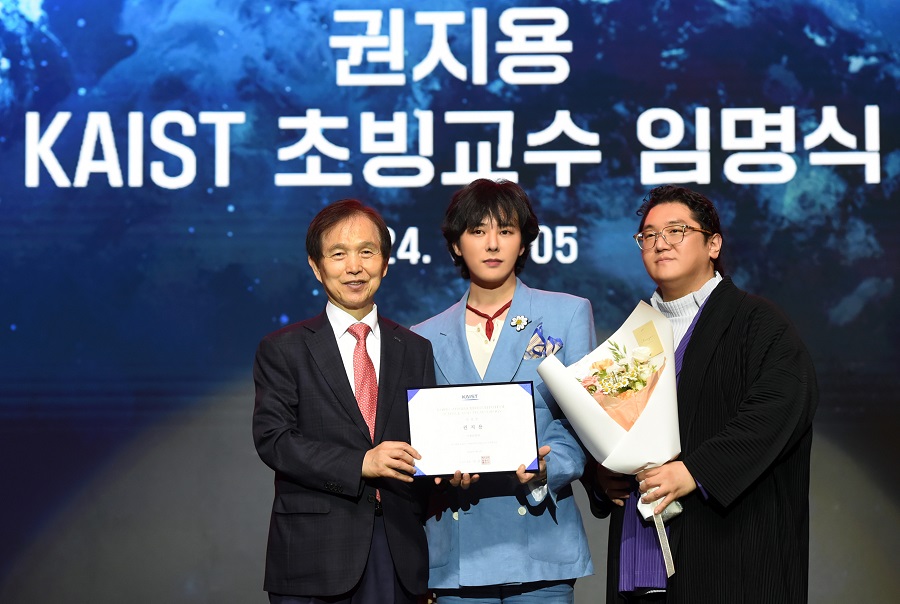 KAIST appoints K-Pop Star “G-Dragon” Kwon Ji-yong as a visiting professor
KAIST (President Kwang Hyung Lee) announced on June 5th that its Department of Mechanical Engineering has appointed Kwon Ji-yong, a K-Pop star better known as G-Dragon, as a visiting professor. The appointment was officiated at the “Innovate Korea 2024” event held at the KAIST Sports Complex in the morning of the 5th.
This appointment was promoted to expand the global competitiveness of Korean culture by applying the latest scientific technology developed from KAIST to K-content and the cultural industry.
An official from Galaxy Corporation, Mr. Kwon’s agency, said, “Through this appointment, we expect to contribute to market innovation and to the global spread and growth of K-culture through research and development of ‘entertech’*.”
* Entertech: A compound word of ‘entertainment’ and ‘technology’ refering to an industry that creates new added value by combining ICT with intellectual property rights (IP) and contents, which are the core values of entertainment.
The newly appointed Visiting Professor Kwon Ji-yong is scheduled to give a special lecture on leadership to undergraduate and graduate students. The purpose is to share his experience and life as a world-class artist to provide KAIST students with vision and insight into the world, as well as the courage and inspiration to pioneer within their own fields of expertise.
In addition, cultural events are planned to be held to help facilitate communication with KAIST members and provide artistic experiences necessary to grow into creative and convergent talents.
Joint research that applies KAIST's various technologies to art and cultural contents will also be pursued. ‘(temporarily named) KAIST-Galaxy Corporation Entertech Research Center’ will be established within the Department of Mechanical Engineering, conducting ▴research on Digital Twin technology for Korean Wave artists, starting with G-Dragon himself ▴convergent research on science and technology encompassing artificial intelligence, robots, and metaverse and K-Culture and ▴research on the development of differentiated avatars of artists using the latest technologies such as volumetrics, motion capture, and haptics.
Galaxy Corporation produces highly talked about televised shows including 'Physical: 100 Season 2', which achieved the feat of ranking first in the Netflix’s ‘Global Top 10 Non-English TV Shows’ category, as well as 'Street Woman Fighter', '2 Days & 1 Night', 'Let's Play Soccer: Mungchyeoya Chanda' and 'Mr. Trot 2', and expanded its IP (intellectual property rights) to all aspects of entertainment, from broadcasting to the music industry by recruiting G-Dragon in December last year.
It is an 'entertech' company that is pioneering a new content market by combining IP with the latest digital technologies such as metaverse, avatar, and artificial intelligence (AI). Based on these achievements, it recently signed a partnership with a global investment bank (IB). Through global investment, the company is soon to be the first entertech startup to become a unicorn (corporate value of 1 trillion won).
Kwon Ji-yong said, “It is an honor to be a visiting professor at KAIST, where countless scientific geniuses come out of. I am hoping the best of science and technology experts and my expertise in the entertainment business will come together and a great synergy, a ‘big bang’ will be ensue as a result.
“More and more musicians are working with artificial intelligence and these cutting-edge technologies enable more diverse forms of creative work,” he continued. He also expressed his specific wish. “Through the AI avatar developed jointly by Galaxy Corporation and KAIST, I wish to communicate more closely with my fans around the world that I cannot meet so often otherwise.”
President Kwang-Hyung Lee said, “Considering that KAIST is a university that has always explored new things and pioneered unknown territories since its establishment, I believe that Kwon Ji-yong also shares KAIST's DNA in that he is a leader and pioneer who has attained world-class achievements in the world of culture and arts.”
President Lee continued expressing his expectations saying, “Kwon Ji-yong will not only contribute to taking KAIST’s science and technology to spread and grow K-culture on the global stage, through his activities but also in sharing his experience and spirit as the trend leader of the world, he will be an asset to the members of KAIST which aims to become a top-tier university.”
The period of Kwon Ji-yong’s professorship is two years from the 4th of this month to June of 2026. In addition, Professor Kwon Ji-yong has been appointed as KAIST’s global ambassador to help strengthen KAIST's international presence.
Professor Kwon Ji-yong, who began his career as G-Dragon, has established himself as an icon symbolizing Korean pop culture over 18 years as a member and the leader of the K-Pop idol group 'Big Bang', which debuted in 2006 and gained global popularity. While being recognized for his outstanding ability in all aspects of his music, from writing lyrics, composing, and producing to performing, he has also been active in fashion, becoming the first Asian man to be selected as a global ambassador for Chanel in 2016, spreading Korean music and fashion to the world.
In June, 2017, he released his 3rd solo album 'Kwon Ji Yong' on USB instead of the existing CD format, for the first time in Korea. He also attended CES, the world's largest home appliance and IT exhibition held in Las Vegas, USA in January of this year, extending his strides as a 'tech-tainer'.
2024.06.05 View 32623
KAIST appoints K-Pop Star “G-Dragon” Kwon Ji-yong as a visiting professor
KAIST (President Kwang Hyung Lee) announced on June 5th that its Department of Mechanical Engineering has appointed Kwon Ji-yong, a K-Pop star better known as G-Dragon, as a visiting professor. The appointment was officiated at the “Innovate Korea 2024” event held at the KAIST Sports Complex in the morning of the 5th.
This appointment was promoted to expand the global competitiveness of Korean culture by applying the latest scientific technology developed from KAIST to K-content and the cultural industry.
An official from Galaxy Corporation, Mr. Kwon’s agency, said, “Through this appointment, we expect to contribute to market innovation and to the global spread and growth of K-culture through research and development of ‘entertech’*.”
* Entertech: A compound word of ‘entertainment’ and ‘technology’ refering to an industry that creates new added value by combining ICT with intellectual property rights (IP) and contents, which are the core values of entertainment.
The newly appointed Visiting Professor Kwon Ji-yong is scheduled to give a special lecture on leadership to undergraduate and graduate students. The purpose is to share his experience and life as a world-class artist to provide KAIST students with vision and insight into the world, as well as the courage and inspiration to pioneer within their own fields of expertise.
In addition, cultural events are planned to be held to help facilitate communication with KAIST members and provide artistic experiences necessary to grow into creative and convergent talents.
Joint research that applies KAIST's various technologies to art and cultural contents will also be pursued. ‘(temporarily named) KAIST-Galaxy Corporation Entertech Research Center’ will be established within the Department of Mechanical Engineering, conducting ▴research on Digital Twin technology for Korean Wave artists, starting with G-Dragon himself ▴convergent research on science and technology encompassing artificial intelligence, robots, and metaverse and K-Culture and ▴research on the development of differentiated avatars of artists using the latest technologies such as volumetrics, motion capture, and haptics.
Galaxy Corporation produces highly talked about televised shows including 'Physical: 100 Season 2', which achieved the feat of ranking first in the Netflix’s ‘Global Top 10 Non-English TV Shows’ category, as well as 'Street Woman Fighter', '2 Days & 1 Night', 'Let's Play Soccer: Mungchyeoya Chanda' and 'Mr. Trot 2', and expanded its IP (intellectual property rights) to all aspects of entertainment, from broadcasting to the music industry by recruiting G-Dragon in December last year.
It is an 'entertech' company that is pioneering a new content market by combining IP with the latest digital technologies such as metaverse, avatar, and artificial intelligence (AI). Based on these achievements, it recently signed a partnership with a global investment bank (IB). Through global investment, the company is soon to be the first entertech startup to become a unicorn (corporate value of 1 trillion won).
Kwon Ji-yong said, “It is an honor to be a visiting professor at KAIST, where countless scientific geniuses come out of. I am hoping the best of science and technology experts and my expertise in the entertainment business will come together and a great synergy, a ‘big bang’ will be ensue as a result.
“More and more musicians are working with artificial intelligence and these cutting-edge technologies enable more diverse forms of creative work,” he continued. He also expressed his specific wish. “Through the AI avatar developed jointly by Galaxy Corporation and KAIST, I wish to communicate more closely with my fans around the world that I cannot meet so often otherwise.”
President Kwang-Hyung Lee said, “Considering that KAIST is a university that has always explored new things and pioneered unknown territories since its establishment, I believe that Kwon Ji-yong also shares KAIST's DNA in that he is a leader and pioneer who has attained world-class achievements in the world of culture and arts.”
President Lee continued expressing his expectations saying, “Kwon Ji-yong will not only contribute to taking KAIST’s science and technology to spread and grow K-culture on the global stage, through his activities but also in sharing his experience and spirit as the trend leader of the world, he will be an asset to the members of KAIST which aims to become a top-tier university.”
The period of Kwon Ji-yong’s professorship is two years from the 4th of this month to June of 2026. In addition, Professor Kwon Ji-yong has been appointed as KAIST’s global ambassador to help strengthen KAIST's international presence.
Professor Kwon Ji-yong, who began his career as G-Dragon, has established himself as an icon symbolizing Korean pop culture over 18 years as a member and the leader of the K-Pop idol group 'Big Bang', which debuted in 2006 and gained global popularity. While being recognized for his outstanding ability in all aspects of his music, from writing lyrics, composing, and producing to performing, he has also been active in fashion, becoming the first Asian man to be selected as a global ambassador for Chanel in 2016, spreading Korean music and fashion to the world.
In June, 2017, he released his 3rd solo album 'Kwon Ji Yong' on USB instead of the existing CD format, for the first time in Korea. He also attended CES, the world's largest home appliance and IT exhibition held in Las Vegas, USA in January of this year, extending his strides as a 'tech-tainer'.
2024.06.05 View 32623 -
 KAIST begins full-scale cooperation with Taiwan’s Formosa Group
< (From left) Senior Vice President for Planning and Budget Kyung-Soo Kim, and Professor Minee Choi of the Department of Brain and Cognitive Sciences of KAIST along with Chairman of Formosa Group Sandy Wang and KAIST President Kwang-Hyung Lee, and Dean Daesoo Kim of KAIST College of Life Science and Bioengineering >
KAIST is pursuing cooperation in the fields of advanced biotechnology and eco-friendly energy with Formosa Plastics Group, one of Taiwan's three largest companies.
To this end, Chairman Sandy Wang, a member of Formosa Group's standing committee and leader of the group's bio and eco-friendly energy sector, will visit KAIST on the 13th of this month. This is the first time that the owner of Formosa Group has made an official visit to KAIST.
Cooperation between the two institutions began last March when our university signed a memorandum of understanding on comprehensive exchange and cooperation with Ming Chi University of Science and Technology (明志科技大學), Chang Gung University(長庚大學), and Chang Gung Memorial Hospital(長庚記念醫院), three of many institutions established and supported by Formosa Group.
Based on this, Chairman Sandy Wang, who visits our university to promote more exchanges and cooperation, talked about ‘the education of children and corporate social return and practice of his father, Chairman Yung-Ching Wang,’ through a special lecture for the school leadership as a part of the Monthly Lecture on KAIST’s Leadership Innovation Day.
She then visited KAIST's research and engineering facilities related to Taiwan's future industries, such as advanced biotechnology and eco-friendly energy, and discussed global industry-academic cooperation plans. In the future, the two organizations plan to appoint adjunct professors and promote practical global cooperation, including joint student guidance and research cooperation. We plan to pursue effective mid- to long-term cooperation, such as conducting battery application research with the KAIST Next-Generation ESS Research Center and opening a graduate program specialized in stem cell and gene editing technology in connection with Chang Gung University and Chang Gung Memorial Hospital. The newly established cooperative relationship will also promote Formosa Group's investment and cooperation with KAIST's outstanding venture companies related to bio and eco-friendly energy to lay the foundation for innovative industrial cooperation between Taiwan and Korea.
President Kwang-Hyung Lee said, “The Formosa Group has a global network, so we regard it to be a key partner that will position KAIST’s bio and engineering technology in the global stages.” He also said, “With Chairman Sandy Wang’s visit, Taiwan is emerging as a global economic powerhouse,” and added, “We expect to continue our close cooperative relationship with the company.”
Formosa Group is a company founded by the late Chairman Yung-Ching Wang, the father of Chairman Sandy Wang. As the world's No. 1 plastic PVC producer, it is leading the core industries of Taiwan's economy, including semiconductors, steel, heavy industry, bio, and batteries. Chairman Yung-Ching Wang was respected by the Taiwanese people by setting an example of returning his wealth to society under the belief that the companies and assets he built ‘belonged to the people.’ Chang Gung University, Chang Gung Memorial Hospital, and Ming Chi University of Technology, which are pursuing cooperation with our university, were also established as part of the social contribution promoted by Chairman Yung-Ching Wang and are receiving financial support from Formosa Group.
2024.05.09 View 15448
KAIST begins full-scale cooperation with Taiwan’s Formosa Group
< (From left) Senior Vice President for Planning and Budget Kyung-Soo Kim, and Professor Minee Choi of the Department of Brain and Cognitive Sciences of KAIST along with Chairman of Formosa Group Sandy Wang and KAIST President Kwang-Hyung Lee, and Dean Daesoo Kim of KAIST College of Life Science and Bioengineering >
KAIST is pursuing cooperation in the fields of advanced biotechnology and eco-friendly energy with Formosa Plastics Group, one of Taiwan's three largest companies.
To this end, Chairman Sandy Wang, a member of Formosa Group's standing committee and leader of the group's bio and eco-friendly energy sector, will visit KAIST on the 13th of this month. This is the first time that the owner of Formosa Group has made an official visit to KAIST.
Cooperation between the two institutions began last March when our university signed a memorandum of understanding on comprehensive exchange and cooperation with Ming Chi University of Science and Technology (明志科技大學), Chang Gung University(長庚大學), and Chang Gung Memorial Hospital(長庚記念醫院), three of many institutions established and supported by Formosa Group.
Based on this, Chairman Sandy Wang, who visits our university to promote more exchanges and cooperation, talked about ‘the education of children and corporate social return and practice of his father, Chairman Yung-Ching Wang,’ through a special lecture for the school leadership as a part of the Monthly Lecture on KAIST’s Leadership Innovation Day.
She then visited KAIST's research and engineering facilities related to Taiwan's future industries, such as advanced biotechnology and eco-friendly energy, and discussed global industry-academic cooperation plans. In the future, the two organizations plan to appoint adjunct professors and promote practical global cooperation, including joint student guidance and research cooperation. We plan to pursue effective mid- to long-term cooperation, such as conducting battery application research with the KAIST Next-Generation ESS Research Center and opening a graduate program specialized in stem cell and gene editing technology in connection with Chang Gung University and Chang Gung Memorial Hospital. The newly established cooperative relationship will also promote Formosa Group's investment and cooperation with KAIST's outstanding venture companies related to bio and eco-friendly energy to lay the foundation for innovative industrial cooperation between Taiwan and Korea.
President Kwang-Hyung Lee said, “The Formosa Group has a global network, so we regard it to be a key partner that will position KAIST’s bio and engineering technology in the global stages.” He also said, “With Chairman Sandy Wang’s visit, Taiwan is emerging as a global economic powerhouse,” and added, “We expect to continue our close cooperative relationship with the company.”
Formosa Group is a company founded by the late Chairman Yung-Ching Wang, the father of Chairman Sandy Wang. As the world's No. 1 plastic PVC producer, it is leading the core industries of Taiwan's economy, including semiconductors, steel, heavy industry, bio, and batteries. Chairman Yung-Ching Wang was respected by the Taiwanese people by setting an example of returning his wealth to society under the belief that the companies and assets he built ‘belonged to the people.’ Chang Gung University, Chang Gung Memorial Hospital, and Ming Chi University of Technology, which are pursuing cooperation with our university, were also established as part of the social contribution promoted by Chairman Yung-Ching Wang and are receiving financial support from Formosa Group.
2024.05.09 View 15448