본문 바로가기
대메뉴 바로가기
KAIST
Newsletter Vol.38
Receive KAIST news by email!
View
Subscribe
Close
Type your e-mail address here.
Subscribe
Close
KAIST
NEWS
유틸열기
홈페이지 통합검색
-
검색
KOREAN
메뉴 열기
%74%6f%6f%74%68%62%72%75%73%68
by recently order
by view order
KAIST Researchers Unveil Technical Principles Behind Antibacterial Graphene Toothbrushes with 10 Million Units Sold
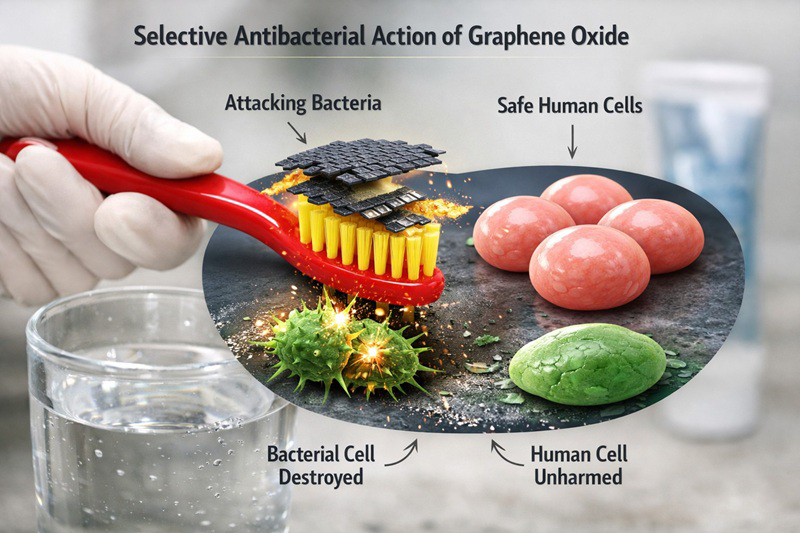
< (From left) Professor Hyun Jung Chung , Ph.D candidate Ju Yeon Chung, Ph.D candidate Sujin Cha, Professor Sang Ouk Kim > Hygiene in everyday items that touch the body—such as clothing, masks, and toothbrushes—is critically important. The underlying principle of how graphene selectively eliminates only bacteria has now been revealed. A KAIST research team has presented the potential for a next-generation antibacterial material that is safe for the human body and capable of replacing antibiotics. KAIST announced on March 25th that a joint research team, led by Professor Sang Ouk Kim from the Department of Materials Science and Engineering and Professor Hyun Jung Chung from the Department of Biological Sciences, has identified the mechanism by which Graphene Oxide (GO) exhibits powerful antibacterial effects against bacteria while remaining harmless to human cells. Graphene oxide is a nanomaterial consisting of an atomic level carbon layer (graphene) with oxygen attached; it is characterized by its ability to mix well with water and implement various functions. This study is highly significant as it provides molecular-level proof of graphene's antibacterial action, which had not been clearly understood until now. The research team confirmed that graphene oxide performs "selective antibacterial action" by attaching to and destroying only the membranes of bacteria, much like a magnet attaches only to specific metals, while leaving human cells untouched. This occurs because the oxygen functional groups on the surface of graphene oxide selectively bind with a specific component (POPG) found only in bacterial cell membranes. Simply put, it recognizes a "target" present only in bacterial membranes to attach and destroy the structure. In this context, phospholipids are fatty components that make up the membrane surrounding a cell, and POPG is a component primarily present in bacteria. < Schematic diagram of the selective interaction between graphene oxide and cell membranes > < Identification of selective interaction mechanisms at the molecular level through microscopic and chemical analysis of artificial lipid vesicles mimicking cell membranes > Nanofibers applying this principle effectively inhibited the growth of various pathogenic bacteria, including superbugs resistant to antibiotics. Animal experiments also confirmed its effectiveness in promoting wound healing without inducing inflammation. < Verification of antibacterial and wound healing enhancement effects in a porcine infected wound model > Furthermore, fibers using this material maintained their antibacterial functions even after multiple washes, showing potential for use in various industrial fields such as apparel and medical textiles. This technology is already being applied to consumer products. The graphene antibacterial toothbrush, released through the original patents of the faculty-led startup 'Materials Creation Co., Ltd.,' has sold over 10 million units, proving its commercial viability. Additionally, GrapheneTex—textile materiala incorporating this technology—was used in the uniforms of the Taekwondo demonstration team at the 2024 Paris Olympics and is expected to play an active role in functional sportswear at upcoming international sporting events like the 2026 Asian Games. < Commercially available graphene toothbrush > < Graphene material image (AI-generated image) > Professor Sang Ouk Kim explained, "This study is an example of scientifically uncovering why graphene can selectively kill bacteria while remaining safe for the human body." He emphasized, "By utilizing this principle, we can expand beyond safe clothing without harsh chemicals to an infinite range of applications, including wearable devices and medical textile systems." Sujin Cha (PhD program, Department of Materials Science and Engineering) and Ju Yeon Chung (Integrated MS/PhD program, Department of Biological Sciences) participated as first authors. Professor Hyun Jung Chung participated as a co-corresponding author. The research was published on March 2nd in the prestigious materials science journal, Advanced Functional Materials. ※ Paper Title: Biocompatible but Antibacterial Mechanism of Graphene Oxide for Sustainable Antibiotics, DOI: 10.1002/adfm.202313583 Additionally, Nanowerk (http://www.nanowerk.com/), a global portal for nanotechnology, featured these findings as a 'Spotlight' titled "Graphene oxide destroys bacteria without harming human tissue." This research was conducted with support from the 'Nano/Material Technology Development (R&D)' program, the 'Individual Basic Research' program, and the 'Mid-Career Researcher Support Program' funded by the Ministry of Science and ICT.
2026.03.26
View 3991
<<
첫번째페이지
<
이전 페이지
1
>
다음 페이지
>>
마지막 페이지 1